Skip to content

Reduced Order Models

jetfuelburn.reducedorder

aim2015

Reduced-order fuel burn model based on Dray et al. (2019).

The class implements the reduced-order fuel burn model of the AIM2015 air transport model (part "Aircraft Performance Model"):
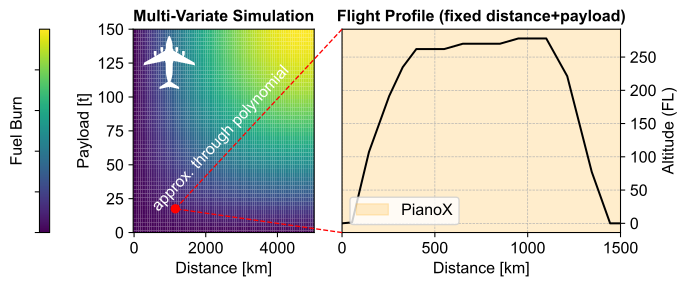
Payload/Range Diagram

In this model, fuel burn calculations are based on a regression model. The regression coefficients were obtained by fitting mission parameters to fuel burn data obtained by simulating flights using the PianoX software.

Fuel burn is calculated according to Section 3.4.1 of the AIM2015 documentation:

\[ \text{Fuel}_{tsp} = I_{ts} \cdot ( \eta_{tsp,0} + \eta_{tsp,1}D + \eta_{tsp,2}D \cdot PL + \eta_{tsp,3}D^2 + \eta_{tsp,4}PL + \eta_{tsp,5}D^2 \cdot PL ) \]

where subscripts \(t,s,p\) denote aircraft \(t\)ype, \(s\)ize class and flight \(p\)hase and where:

Symbol Dimension Description
\(I\) [dimensionless] non-linear inefficiency parameter
\(D\) [length] distance flown in flight phase
\(PL\) [mass] payload mass
\(\eta\) varies regression coefficients

For information on the inefficiency parameter \(I\), see the conference publication of Reynolds (2009).

Notes

Data is available for 8 aircraft size classes, as defined in the AIM2015 documentation, Section 2.3, Table 1:

Index Size Category PAX Number Reference Aircraft Reference Engine
1 Small Regional Jet 30-69 CRJ 700 GE CF34 8C5B1
2 Large Regional Jet 70-109 Embraer 190 GE CF34 10E6
3 Small Narrowbody 110-129 Airbus A319 V.2522
4 Medium Narrowbody 130-159 Airbus A320 CFM56-5B4
5 Large Narrowbody 160-199 Boeing 737-800 CFM56-7B27
6 Small Twin Aisle 200-249 Boeing 787-800 GEnx-1B67
7 Medium Twin Aisle 259-299 Airbus A330-300 Trent 772B
8 Large Twin Aisle 300-399 Boeing 777-300ER PW4090

Key assumptions of this fuel calculation function:

Parameter Assumption
data availability 8 selected aircraft, which can be used as proxies within their weight class
aircraft payload variable
climb/descent considered separately
reserve fuel uplift considered implicitly (?)
diversion fuel uplift considered implicitly (?)
Warnings

While the AIM2015 documentation lists the Boeing 777-300ER using the PW4090 engine, this aircraft variant was exclusively powered by GE90 engines.

See Also

Class AircraftPerformanceParams in aim/v11/datastructures/AircraftPerformanceParams

References
Example

Editor (session: default) Run
import jetfuelburn
from jetfuelburn import ureg
from jetfuelburn.reducedorder import aim2015
aim2015.calculate_fuel_consumption(
    acft_size_class=8,
    D_climb=300*ureg.km,
    D_cruise=(15000-300-200)*ureg.km,
    D_descent=200*ureg.km,
    PL=55.5*ureg.metric_ton
)
Output Clear
Source code in jetfuelburn/reducedorder.py
class aim2015:
    r"""
    Reduced-order fuel burn model based on Dray et al. (2019).

    The class implements the reduced-order fuel burn model of the [AIM2015 air transport model](https://www.atslab.org/data-tools/) (part "Aircraft Performance Model"):

    ![Payload/Range Diagram](../_static/reduced_order_aim2015.svg)

    In this model, fuel burn calculations are based on a regression model.
    The regression coefficients were obtained by fitting mission parameters to fuel burn data obtained
    by simulating flights using the [PianoX software](https://www.lissys.uk/PianoX.html).

    Fuel burn is calculated according to Section 3.4.1 of the AIM2015 documentation:

    $$
        \text{Fuel}_{tsp} = I_{ts} \cdot ( \eta_{tsp,0} + \eta_{tsp,1}D + \eta_{tsp,2}D \cdot PL + \eta_{tsp,3}D^2 + \eta_{tsp,4}PL + \eta_{tsp,5}D^2 \cdot PL )
    $$

    where subscripts $t,s,p$ denote aircraft $t$ype, $s$ize class and flight $p$hase and where:

    | Symbol     | Dimension         | Description                                                            |
    |------------|-------------------|------------------------------------------------------------------------|
    | $I$        | [dimensionless]   | non-linear inefficiency parameter                                      |
    | $D$        | [length]          | distance flown in flight phase                                         |
    | $PL$       | [mass]            | payload mass                                                           |
    | $\eta$     | varies            | regression coefficients                                                |

    For information on the inefficiency parameter $I$, see the conference publication of Reynolds (2009).

    Notes
    -----
    Data is available for 8 aircraft size classes, as defined in the AIM2015 documentation, Section 2.3, Table 1:

    | Index | Size Category         | PAX Number    | Reference Aircraft | Reference Engine     |
    |-------|-----------------------|---------------|--------------------|----------------------|
    | 1     | Small Regional Jet    | 30-69         | CRJ 700            | GE CF34 8C5B1        |
    | 2     | Large Regional Jet    | 70-109        | Embraer 190        | GE CF34 10E6         |
    | 3     | Small Narrowbody      | 110-129       | Airbus A319        | V.2522               |
    | 4     | Medium Narrowbody     | 130-159       | Airbus A320        | CFM56-5B4            |
    | 5     | Large Narrowbody      | 160-199       | Boeing 737-800     | CFM56-7B27           |
    | 6     | Small Twin Aisle      | 200-249       | Boeing 787-800     | GEnx-1B67            |
    | 7     | Medium Twin Aisle     | 259-299       | Airbus A330-300    | Trent 772B           |
    | 8     | Large Twin Aisle      | 300-399       | Boeing 777-300ER   | PW4090               |

    Key assumptions of this fuel calculation function:

    | Parameter             | Assumption                                                                  |
    |-----------------------|-----------------------------------------------------------------------------|
    | data availability     | 8 selected aircraft, which can be used as proxies within their weight class |
    | aircraft payload      | variable                                                                    |
    | climb/descent         | considered separately                                                       |
    | reserve fuel uplift   | considered implicitly (?)                                                   |
    | diversion fuel uplift | considered implicitly (?)                                                   |

    Warnings
    --------
    While the AIM2015 documentation lists the Boeing 777-300ER using the PW4090 engine,
    this aircraft variant [was exclusively powered by GE90 engines](https://en.wikipedia.org/wiki/Boeing_777#Engines).

    See Also
    --------
    Class `AircraftPerformanceParams` in `aim/v11/datastructures/AircraftPerformanceParams`

    References
    ----------
    - Dray, L. M., Krammer, P., Doyme, K., Wang, B., Al Zayat, K., O'Sullivan, A., & Schäfer, A. W. (2019).
    AIM2015: Validation and initial results from an open-source aviation systems model.
    _Transport Policy_, 79, 93-102.
    doi:[10.1016/j.tranpol.2019.04.013](https://doi.org/10.1016/j.tranpol.2019.04.013)
    - Reynolds, T. G. (2009).
    Development of flight inefficiency metrics for environmental performance assessment of ATM.
    In _8th USA/Europe Seminar on Air Traffic Management Research and Development (ATM2009)_.
    Full Text: [Archived Copy from atslab.org](https://web.archive.org/web/20220721111106/http://www.atslab.org/wp-content/uploads/2017/01/ATM2009_Reynoldsv2.pdf)
    - [AIM2015 documentation (v9)](https://web.archive.org/web/20241206191807/https://www.atslab.org/wp-content/uploads/2019/12/AIM-2015-Documentation-v9-122019.pdf)
    - [AIM2015 documentation (v11)](https://web.archive.org/web/20231001131622/https://www.atslab.org/wp-content/uploads/2023/02/AIM-2015-Documentation-v11.pdf)
    - [AIM2015 information in the EU MIDAS system](https://web.jrc.ec.europa.eu/policy-model-inventory/explore/models/model-aim/)

    Example
    -------
    ```pyodide install='jetfuelburn'
    import jetfuelburn
    from jetfuelburn import ureg
    from jetfuelburn.reducedorder import aim2015
    aim2015.calculate_fuel_consumption(
        acft_size_class=8,
        D_climb=300*ureg.km,
        D_cruise=(15000-300-200)*ureg.km,
        D_descent=200*ureg.km,
        PL=55.5*ureg.metric_ton
    )
    ```
    """

    _regression_coefficients = {}
    with resources.open_text(
        "jetfuelburn.data.AIM2015", "AIM2015_v11_AircraftPerformanceParams.csv"
    ) as file:
        csv_reader = csv.DictReader(file)
        for row in csv_reader:
            variable = row.pop("Variable")
            _regression_coefficients[variable] = {
                key: float(value) for key, value in row.items()
            }

    @staticmethod
    def available_aircraft() -> list[str]:
        """
        Returns a sorted list of available ICAO aircraft designators included in the model.
        """
        return sorted(["CRJ7", "E190", "A319", "A320", "B738", "B788", "A333", "B77W"])

    @staticmethod
    @ureg.check(
        None,
        "[length]",
        "[length]",
        "[length]",
        "[mass]",
    )
    def calculate_fuel_consumption(
        acft_size_class: int,
        D_climb: float,
        D_cruise: float,
        D_descent: float,
        PL: float,
    ) -> dict[float, float, float]:
        """
        Given an aircraft size class integer, payload and distances for climb, cruise, and descent, calculates the fuel burned during flight.

        Parameters
        ----------
        acft_size_class : int
            Aircraft size class (1-8)
        D_climb : ureg.Quantity
            Climb distance [length]
        D_cruise : ureg.Quantity
            Cruise distance [length]
        D_descent : ureg.Quantity
            Descent distance [length]
        PL : ureg.Quantity
            Payload [mass]

        Raises
        ------
        ValueError
            If range or payload is negative, or if the aircraft size class is not between 1 and 8.

        Returns
        -------
        dict
            'mass_fuel_climb' : ureg.Quantity
                Fuel mass (climb segment) [kg]
            'mass_fuel_cruise' : ureg.Quantity
                Fuel mass (cruise segment) [kg]
            'mass_fuel_descent' : ureg.Quantity
                Fuel mass (descent segment) [kg]
        """
        if D_climb.magnitude < 0:
            raise ValueError("Climb distance must be non-negative.")
        if D_cruise.magnitude < 0:
            raise ValueError("Cruise distance must be non-negative.")
        if D_descent.magnitude < 0:
            raise ValueError("Descent distance must be non-negative.")
        if PL.magnitude < 0:
            raise ValueError("Payload must be non-negative.")
        if acft_size_class not in range(1, 9):
            raise ValueError(
                "Aircraft size class must be between 1 and 8. Compare the table in the class documentation."
            )

        D_climb = D_climb.to("km").magnitude
        D_cruise = D_cruise.to("km").magnitude
        D_descent = D_descent.to("km").magnitude
        PL = PL.to("kg").magnitude

        m_f_climb = (
            aim2015._regression_coefficients["ClimboutFuel_kg_Intercept"][
                f"Param_Size{acft_size_class}"
            ]
            + aim2015._regression_coefficients["ClimboutFuel_kg_Dist_km"][
                f"Param_Size{acft_size_class}"
            ]
            * D_climb
            + aim2015._regression_coefficients["ClimboutFuel_kg_Dist_km_x_Payload_kg"][
                f"Param_Size{acft_size_class}"
            ]
            * D_climb
            * PL
            + aim2015._regression_coefficients["ClimboutFuel_kg_Dist_km_squared"][
                f"Param_Size{acft_size_class}"
            ]
            * D_climb**2
            + aim2015._regression_coefficients["ClimboutFuel_kg_Payload_kg"][
                f"Param_Size{acft_size_class}"
            ]
            * PL
            + aim2015._regression_coefficients[
                "ClimboutFuel_kg_Dist_km_squared_x_Payload_kg"
            ][f"Param_Size{acft_size_class}"]
            * D_climb**2
            * PL
        )
        m_f_cruise = (
            aim2015._regression_coefficients["CruiseFuel_kg_Intercept"][
                f"Param_Size{acft_size_class}"
            ]
            + aim2015._regression_coefficients["CruiseFuel_kg_Dist_km"][
                f"Param_Size{acft_size_class}"
            ]
            * D_cruise
            + aim2015._regression_coefficients["CruiseFuel_kg_Dist_km_x_Payload_kg"][
                f"Param_Size{acft_size_class}"
            ]
            * D_cruise
            * PL
            + aim2015._regression_coefficients["CruiseFuel_kg_Dist_km_squared"][
                f"Param_Size{acft_size_class}"
            ]
            * D_cruise**2
            + aim2015._regression_coefficients["CruiseFuel_kg_Payload_kg"][
                f"Param_Size{acft_size_class}"
            ]
            * PL
            + aim2015._regression_coefficients[
                "CruiseFuel_kg_Dist_km_squared_x_Payload_kg"
            ][f"Param_Size{acft_size_class}"]
            * D_cruise**2
            * PL
        )
        m_f_descent = (
            aim2015._regression_coefficients["DescentFuel_kg_Intercept"][
                f"Param_Size{acft_size_class}"
            ]
            + aim2015._regression_coefficients["DescentFuel_kg_Dist_km"][
                f"Param_Size{acft_size_class}"
            ]
            * D_descent
            + aim2015._regression_coefficients["DescentFuel_kg_Dist_km_x_Payload_kg"][
                f"Param_Size{acft_size_class}"
            ]
            * D_descent
            * PL
            + aim2015._regression_coefficients["DescentFuel_kg_Dist_km_squared"][
                f"Param_Size{acft_size_class}"
            ]
            * D_descent**2
            + aim2015._regression_coefficients["DescentFuel_kg_Payload_kg"][
                f"Param_Size{acft_size_class}"
            ]
            * PL
            + aim2015._regression_coefficients[
                "DescentFuel_kg_Dist_km_squared_x_Payload_kg"
            ][f"Param_Size{acft_size_class}"]
            * D_descent**2
            * PL
        )

        return {
            "mass_fuel_climb": m_f_climb * ureg("kg"),
            "mass_fuel_cruise": m_f_cruise * ureg("kg"),
            "mass_fuel_descent": m_f_descent * ureg("kg"),
        }

available_aircraft staticmethod

available_aircraft()

Returns a sorted list of available ICAO aircraft designators included in the model.

Source code in jetfuelburn/reducedorder.py
@staticmethod
def available_aircraft() -> list[str]:
    """
    Returns a sorted list of available ICAO aircraft designators included in the model.
    """
    return sorted(["CRJ7", "E190", "A319", "A320", "B738", "B788", "A333", "B77W"])

calculate_fuel_consumption staticmethod

calculate_fuel_consumption(
    acft_size_class, D_climb, D_cruise, D_descent, PL
)

Given an aircraft size class integer, payload and distances for climb, cruise, and descent, calculates the fuel burned during flight.

Parameters:

Name Type Description Default
acft_size_class int

Aircraft size class (1-8)

required
D_climb Quantity

Climb distance [length]

required
D_cruise Quantity

Cruise distance [length]

required
D_descent Quantity

Descent distance [length]

required
PL Quantity

Payload [mass]

required

Raises:

Type Description
ValueError

If range or payload is negative, or if the aircraft size class is not between 1 and 8.

Returns:

Type Description
dict

'mass_fuel_climb' : ureg.Quantity Fuel mass (climb segment) [kg] 'mass_fuel_cruise' : ureg.Quantity Fuel mass (cruise segment) [kg] 'mass_fuel_descent' : ureg.Quantity Fuel mass (descent segment) [kg]

Source code in jetfuelburn/reducedorder.py
@staticmethod
@ureg.check(
    None,
    "[length]",
    "[length]",
    "[length]",
    "[mass]",
)
def calculate_fuel_consumption(
    acft_size_class: int,
    D_climb: float,
    D_cruise: float,
    D_descent: float,
    PL: float,
) -> dict[float, float, float]:
    """
    Given an aircraft size class integer, payload and distances for climb, cruise, and descent, calculates the fuel burned during flight.

    Parameters
    ----------
    acft_size_class : int
        Aircraft size class (1-8)
    D_climb : ureg.Quantity
        Climb distance [length]
    D_cruise : ureg.Quantity
        Cruise distance [length]
    D_descent : ureg.Quantity
        Descent distance [length]
    PL : ureg.Quantity
        Payload [mass]

    Raises
    ------
    ValueError
        If range or payload is negative, or if the aircraft size class is not between 1 and 8.

    Returns
    -------
    dict
        'mass_fuel_climb' : ureg.Quantity
            Fuel mass (climb segment) [kg]
        'mass_fuel_cruise' : ureg.Quantity
            Fuel mass (cruise segment) [kg]
        'mass_fuel_descent' : ureg.Quantity
            Fuel mass (descent segment) [kg]
    """
    if D_climb.magnitude < 0:
        raise ValueError("Climb distance must be non-negative.")
    if D_cruise.magnitude < 0:
        raise ValueError("Cruise distance must be non-negative.")
    if D_descent.magnitude < 0:
        raise ValueError("Descent distance must be non-negative.")
    if PL.magnitude < 0:
        raise ValueError("Payload must be non-negative.")
    if acft_size_class not in range(1, 9):
        raise ValueError(
            "Aircraft size class must be between 1 and 8. Compare the table in the class documentation."
        )

    D_climb = D_climb.to("km").magnitude
    D_cruise = D_cruise.to("km").magnitude
    D_descent = D_descent.to("km").magnitude
    PL = PL.to("kg").magnitude

    m_f_climb = (
        aim2015._regression_coefficients["ClimboutFuel_kg_Intercept"][
            f"Param_Size{acft_size_class}"
        ]
        + aim2015._regression_coefficients["ClimboutFuel_kg_Dist_km"][
            f"Param_Size{acft_size_class}"
        ]
        * D_climb
        + aim2015._regression_coefficients["ClimboutFuel_kg_Dist_km_x_Payload_kg"][
            f"Param_Size{acft_size_class}"
        ]
        * D_climb
        * PL
        + aim2015._regression_coefficients["ClimboutFuel_kg_Dist_km_squared"][
            f"Param_Size{acft_size_class}"
        ]
        * D_climb**2
        + aim2015._regression_coefficients["ClimboutFuel_kg_Payload_kg"][
            f"Param_Size{acft_size_class}"
        ]
        * PL
        + aim2015._regression_coefficients[
            "ClimboutFuel_kg_Dist_km_squared_x_Payload_kg"
        ][f"Param_Size{acft_size_class}"]
        * D_climb**2
        * PL
    )
    m_f_cruise = (
        aim2015._regression_coefficients["CruiseFuel_kg_Intercept"][
            f"Param_Size{acft_size_class}"
        ]
        + aim2015._regression_coefficients["CruiseFuel_kg_Dist_km"][
            f"Param_Size{acft_size_class}"
        ]
        * D_cruise
        + aim2015._regression_coefficients["CruiseFuel_kg_Dist_km_x_Payload_kg"][
            f"Param_Size{acft_size_class}"
        ]
        * D_cruise
        * PL
        + aim2015._regression_coefficients["CruiseFuel_kg_Dist_km_squared"][
            f"Param_Size{acft_size_class}"
        ]
        * D_cruise**2
        + aim2015._regression_coefficients["CruiseFuel_kg_Payload_kg"][
            f"Param_Size{acft_size_class}"
        ]
        * PL
        + aim2015._regression_coefficients[
            "CruiseFuel_kg_Dist_km_squared_x_Payload_kg"
        ][f"Param_Size{acft_size_class}"]
        * D_cruise**2
        * PL
    )
    m_f_descent = (
        aim2015._regression_coefficients["DescentFuel_kg_Intercept"][
            f"Param_Size{acft_size_class}"
        ]
        + aim2015._regression_coefficients["DescentFuel_kg_Dist_km"][
            f"Param_Size{acft_size_class}"
        ]
        * D_descent
        + aim2015._regression_coefficients["DescentFuel_kg_Dist_km_x_Payload_kg"][
            f"Param_Size{acft_size_class}"
        ]
        * D_descent
        * PL
        + aim2015._regression_coefficients["DescentFuel_kg_Dist_km_squared"][
            f"Param_Size{acft_size_class}"
        ]
        * D_descent**2
        + aim2015._regression_coefficients["DescentFuel_kg_Payload_kg"][
            f"Param_Size{acft_size_class}"
        ]
        * PL
        + aim2015._regression_coefficients[
            "DescentFuel_kg_Dist_km_squared_x_Payload_kg"
        ][f"Param_Size{acft_size_class}"]
        * D_descent**2
        * PL
    )

    return {
        "mass_fuel_climb": m_f_climb * ureg("kg"),
        "mass_fuel_cruise": m_f_cruise * ureg("kg"),
        "mass_fuel_descent": m_f_descent * ureg("kg"),
    }

eea_emission_inventory_2009

The class implements the reduced-order fuel burn model of the EMEP/EEA air pollutant emission inventory guidebook (2009).
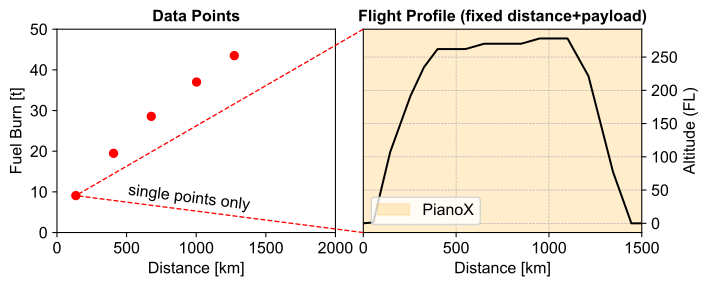
Payload/Range Diagram

In this model, fuel burn calculations are based on a regression model. The regression coefficients were obtained by fitting mission parameters to fuel burn data obtained by simulating flights using the PianoX software.

Key assumptions of this fuel calculation function:

Parameter Assumption
data availability 19 selected aircraft
aircraft payload fixed, unclear
climb/descent not considered separately
reserve fuel uplift considered implicitly (?)
diversion fuel uplift considered implicitly (?)
References
Notes

Data on military and transport aircraft from the sub-table 1.A.3.a Aviation vs2.3spreadsheet2-1updated2007.xlsx used with permission by the Swedish Defence Research Agency (foi.se). Note that this data may be a poor representation of newer variants of the same aircraft types.

Warnings

Note that only EEA data between 1999-2009 was based on Piano simulations, as documented in the Aviation_annex.zip file. Later versions of the EEA guidebook (2013, 2016, 2019, 2023) instead use the Eurocontrol Advanced Emission Model (AEM), as documented in the respective guidebook files. These later models could not be incorporated into jetfuelburn for licensing reasons.

Example

Editor (session: default) Run
import jetfuelburn
from jetfuelburn import ureg
from jetfuelburn.reducedorder import eea_emission_inventory_2009
eea_emission_inventory_2009.calculate_fuel_consumption(
    acft='A320',
    R=1500*ureg.km
)
Output Clear
Source code in jetfuelburn/reducedorder.py
class eea_emission_inventory_2009:
    r"""
    The class implements the reduced-order fuel burn model of the [EMEP/EEA air pollutant emission inventory guidebook](https://www.eea.europa.eu/en/analysis/publications/emep-eea-guidebook-2023) (2009).

    ![Payload/Range Diagram](../_static/reduced_order_eea2009.svg)

    In this model, fuel burn calculations are based on a regression model.
    The regression coefficients were obtained by fitting mission parameters to fuel burn data obtained
    by simulating flights using the [PianoX software](https://www.lissys.uk/PianoX.html).

    Key assumptions of this fuel calculation function:

    | Parameter             | Assumption                                                                  |
    |-----------------------|-----------------------------------------------------------------------------|
    | data availability     | 19 selected aircraft                                                        |
    | aircraft payload      | fixed, unclear                                                              |
    | climb/descent         | not considered separately                                                   |
    | reserve fuel uplift   | considered implicitly (?)                                                   |
    | diversion fuel uplift | considered implicitly (?)                                                   |

    References
    ----------
    - [EMEP/EEA air pollutant emission inventory guidebook - 2009, Part B, Section 1 (Energy), Subsection 1.A.3.a (`Aviation_annex.zip`)](https://www.eea.europa.eu/en/analysis/publications/emep-eea-emission-inventory-guidebook-2009)

    Notes
    -----
    Data on military and transport aircraft from the sub-table `1.A.3.a Aviation vs2.3spreadsheet2-1updated2007.xlsx`
    [used with permission](../_static/permissions/opensky_network_data_access_confirmation.pdf)
    by the Swedish Defence Research Agency (foi.se). Note that this data may be a poor representation of
    newer variants of the same aircraft types.

    Warnings
    --------
    Note that only EEA data between 1999-2009 was based on Piano simulations, as documented in the `Aviation_annex.zip` file.
    Later versions of the EEA guidebook (2013, 2016, 2019, 2023) instead use the Eurocontrol Advanced Emission Model (AEM), as documented in the respective guidebook files.
    These later models could not be incorporated into `jetfuelburn` for licensing reasons.

    Example
    -------
    ```pyodide install='jetfuelburn'
    import jetfuelburn
    from jetfuelburn import ureg
    from jetfuelburn.reducedorder import eea_emission_inventory_2009
    eea_emission_inventory_2009.calculate_fuel_consumption(
        acft='A320',
        R=1500*ureg.km
    )
    ```
    """

    _aircraft_data = {}
    with resources.open_text("jetfuelburn.data.EEA2009", "data.json") as file:
        _aircraft_data = json.load(file)

    @staticmethod
    def available_aircraft() -> list[str]:
        """
        Returns a sorted list of available ICAO aircraft designators included in the model.
        """
        return sorted(eea_emission_inventory_2009._aircraft_data.keys())

    @staticmethod
    @ureg.check(
        None,
        "[length]",
    )
    def calculate_fuel_consumption(
        acft: str,
        R: float,
    ) -> dict:
        r"""
        Given an aircraft name and range, calculates the fuel burned during flight.

        Data between reported range/fuel-burn points is extrapolated linearly:

        $$
            m_F(R=200) = m_F(125) + (200-125) \cdot \frac{m_F(250) - m_F(125)}{250 - 125}
        $$

        where in this example, data is available for $R=[125,250]$ miles and a user-defined range of $R=200$ miles is requested.

        | Symbol     | Dimension         | Description                                                            |
        |------------|-------------------|------------------------------------------------------------------------|
        | $m_F$      | [mass]            | fuel mass burned during flight                                         |
        | $R$        | [length]          | mission range                                                          |


        Parameters
        ----------
        acft : str
            ICAO Aircraft Designator. Note that some aircraft
        R : ureg.Quantity
            Mission range [length]

        Returns
        -------
        dict
            'mass_fuel_total' : ureg.Quantity
                Fuel mass (total segment) [kg]
            'mass_fuel_LTO' : ureg.Quantity
                Fuel mass (LTO segment) [kg]
            'mass_fuel_taxi_in' : ureg.Quantity
                Fuel mass (taxi-in segment) [kg]
            'mass_fuel_climbout' : ureg.Quantity
                Fuel mass (climbout segment) [kg]
            'mass_fuel_takeoff' : ureg.Quantity
                Fuel mass (takeoff segment) [kg]
            'mass_fuel_climb_cruise_descent' : ureg.Quantity
                Fuel mass (climb, cruise, and descent segments) [kg]
            'mass_fuel_approach_landing' : ureg.Quantity
                Fuel mass (approach and landing segment) [kg]
            'mass_fuel_taxi_out' : ureg.Quantity

        Raises
        ------
        ValueError
            If the ICAO Aircraft Designator is not found in the model data.
        ValueError
            If the range is negative or the range is outside the available data range for the given aircraft.
        """

        R = R.to("nmi").magnitude

        if acft not in eea_emission_inventory_2009._aircraft_data:
            raise ValueError(
                f"ICAO Aircraft Designator '{acft}' not found in model data."
            )
        else:
            aircraft_data = eea_emission_inventory_2009._aircraft_data[acft]
            list_distance_points = sorted(
                [int(k) for k in aircraft_data["total"].keys()]
            )

        if R < list_distance_points[0]:
            raise ValueError(f"Range must be at least {list_distance_points[0]} nmi.")
        if R > list_distance_points[-1]:
            raise ValueError(f"Range must be at most {list_distance_points[-1]} nmi.")

        list_flight_phases = [
            "total",
            "LTO",
            "taxi_in",
            "climbout",
            "takeoff",
            "climb_cruise_descent",
            "approach_landing",
            "taxi_out",
        ]

        dict_fuel_burn = {}
        for flight_phase in list_flight_phases:
            dict_fuel_burn_per_distance = {
                int(key): value for key, value in aircraft_data[flight_phase].items()
            }

            for index_distance_point in range(len(list_distance_points) - 1):
                if (
                    list_distance_points[index_distance_point]
                    <= R
                    < list_distance_points[index_distance_point + 1]
                ):
                    x1, x2 = (
                        list_distance_points[index_distance_point],
                        list_distance_points[index_distance_point + 1],
                    )
                    y1, y2 = (
                        dict_fuel_burn_per_distance[x1],
                        dict_fuel_burn_per_distance[x2],
                    )
                    dict_fuel_burn[flight_phase] = y1 + (R - x1) * (y2 - y1) / (x2 - x1)
                    break
            # If R equals the last key value
            if R == list_distance_points[-1]:
                dict_fuel_burn[flight_phase] = dict_fuel_burn_per_distance[
                    list_distance_points[-1]
                ]

        dict_fuel_burn_result = {}
        for key, value in dict_fuel_burn.items():
            dict_fuel_burn_result[f"mass_fuel_{key}"] = value * ureg("kg")

        return dict_fuel_burn_result

available_aircraft staticmethod

available_aircraft()

Returns a sorted list of available ICAO aircraft designators included in the model.

Source code in jetfuelburn/reducedorder.py
@staticmethod
def available_aircraft() -> list[str]:
    """
    Returns a sorted list of available ICAO aircraft designators included in the model.
    """
    return sorted(eea_emission_inventory_2009._aircraft_data.keys())

calculate_fuel_consumption staticmethod

calculate_fuel_consumption(acft, R)

Given an aircraft name and range, calculates the fuel burned during flight.

Data between reported range/fuel-burn points is extrapolated linearly:

\[ m_F(R=200) = m_F(125) + (200-125) \cdot \frac{m_F(250) - m_F(125)}{250 - 125} \]

where in this example, data is available for \(R=[125,250]\) miles and a user-defined range of \(R=200\) miles is requested.

Symbol Dimension Description
\(m_F\) [mass] fuel mass burned during flight
\(R\) [length] mission range

Parameters:

Name Type Description Default
acft str

ICAO Aircraft Designator. Note that some aircraft

required
R Quantity

Mission range [length]

required

Returns:

Type Description
dict

'mass_fuel_total' : ureg.Quantity Fuel mass (total segment) [kg] 'mass_fuel_LTO' : ureg.Quantity Fuel mass (LTO segment) [kg] 'mass_fuel_taxi_in' : ureg.Quantity Fuel mass (taxi-in segment) [kg] 'mass_fuel_climbout' : ureg.Quantity Fuel mass (climbout segment) [kg] 'mass_fuel_takeoff' : ureg.Quantity Fuel mass (takeoff segment) [kg] 'mass_fuel_climb_cruise_descent' : ureg.Quantity Fuel mass (climb, cruise, and descent segments) [kg] 'mass_fuel_approach_landing' : ureg.Quantity Fuel mass (approach and landing segment) [kg] 'mass_fuel_taxi_out' : ureg.Quantity

Raises:

Type Description
ValueError

If the ICAO Aircraft Designator is not found in the model data.

ValueError

If the range is negative or the range is outside the available data range for the given aircraft.

Source code in jetfuelburn/reducedorder.py
@staticmethod
@ureg.check(
    None,
    "[length]",
)
def calculate_fuel_consumption(
    acft: str,
    R: float,
) -> dict:
    r"""
    Given an aircraft name and range, calculates the fuel burned during flight.

    Data between reported range/fuel-burn points is extrapolated linearly:

    $$
        m_F(R=200) = m_F(125) + (200-125) \cdot \frac{m_F(250) - m_F(125)}{250 - 125}
    $$

    where in this example, data is available for $R=[125,250]$ miles and a user-defined range of $R=200$ miles is requested.

    | Symbol     | Dimension         | Description                                                            |
    |------------|-------------------|------------------------------------------------------------------------|
    | $m_F$      | [mass]            | fuel mass burned during flight                                         |
    | $R$        | [length]          | mission range                                                          |


    Parameters
    ----------
    acft : str
        ICAO Aircraft Designator. Note that some aircraft
    R : ureg.Quantity
        Mission range [length]

    Returns
    -------
    dict
        'mass_fuel_total' : ureg.Quantity
            Fuel mass (total segment) [kg]
        'mass_fuel_LTO' : ureg.Quantity
            Fuel mass (LTO segment) [kg]
        'mass_fuel_taxi_in' : ureg.Quantity
            Fuel mass (taxi-in segment) [kg]
        'mass_fuel_climbout' : ureg.Quantity
            Fuel mass (climbout segment) [kg]
        'mass_fuel_takeoff' : ureg.Quantity
            Fuel mass (takeoff segment) [kg]
        'mass_fuel_climb_cruise_descent' : ureg.Quantity
            Fuel mass (climb, cruise, and descent segments) [kg]
        'mass_fuel_approach_landing' : ureg.Quantity
            Fuel mass (approach and landing segment) [kg]
        'mass_fuel_taxi_out' : ureg.Quantity

    Raises
    ------
    ValueError
        If the ICAO Aircraft Designator is not found in the model data.
    ValueError
        If the range is negative or the range is outside the available data range for the given aircraft.
    """

    R = R.to("nmi").magnitude

    if acft not in eea_emission_inventory_2009._aircraft_data:
        raise ValueError(
            f"ICAO Aircraft Designator '{acft}' not found in model data."
        )
    else:
        aircraft_data = eea_emission_inventory_2009._aircraft_data[acft]
        list_distance_points = sorted(
            [int(k) for k in aircraft_data["total"].keys()]
        )

    if R < list_distance_points[0]:
        raise ValueError(f"Range must be at least {list_distance_points[0]} nmi.")
    if R > list_distance_points[-1]:
        raise ValueError(f"Range must be at most {list_distance_points[-1]} nmi.")

    list_flight_phases = [
        "total",
        "LTO",
        "taxi_in",
        "climbout",
        "takeoff",
        "climb_cruise_descent",
        "approach_landing",
        "taxi_out",
    ]

    dict_fuel_burn = {}
    for flight_phase in list_flight_phases:
        dict_fuel_burn_per_distance = {
            int(key): value for key, value in aircraft_data[flight_phase].items()
        }

        for index_distance_point in range(len(list_distance_points) - 1):
            if (
                list_distance_points[index_distance_point]
                <= R
                < list_distance_points[index_distance_point + 1]
            ):
                x1, x2 = (
                    list_distance_points[index_distance_point],
                    list_distance_points[index_distance_point + 1],
                )
                y1, y2 = (
                    dict_fuel_burn_per_distance[x1],
                    dict_fuel_burn_per_distance[x2],
                )
                dict_fuel_burn[flight_phase] = y1 + (R - x1) * (y2 - y1) / (x2 - x1)
                break
        # If R equals the last key value
        if R == list_distance_points[-1]:
            dict_fuel_burn[flight_phase] = dict_fuel_burn_per_distance[
                list_distance_points[-1]
            ]

    dict_fuel_burn_result = {}
    for key, value in dict_fuel_burn.items():
        dict_fuel_burn_result[f"mass_fuel_{key}"] = value * ureg("kg")

    return dict_fuel_burn_result

lee_etal

This class implements the the reduced-order fuel burn model of Lee et al. (2010).
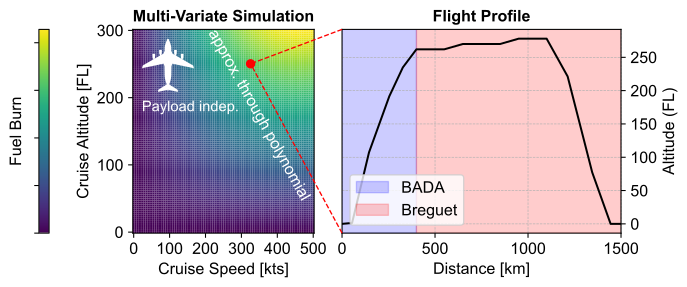
Payload/Range Diagram

In this model, fuel burn calculations are based on a regression model. The regression coefficients were obtained by fitting mission parameters to fuel burn data obtained from a combination of Eurocontrol BADA flight trajectory simulation model and the Breguet range equation. Climb segment fuel burn is calculated using the Eurocontrol BADA model. Descent segment fuel burn is assumed equal to cruise segment fuel burn. Cruise segment fuel burn is calculated using the Breguet range equation.

For the equations implemented in this class, see Lee et al. (2010), Eqns.(13)ff. and Figure 5.

Notes

Key assumptions of this fuel calculation function:

Parameter Assumption
data availability 21 selected aircraft
aircraft payload variable
climb/descent considered implicitly
reserve fuel uplift assumed constant at 0.08 zero-fuel weight (cf. P.4)
diversion fuel uplift unclear (cf. P.4)
References

Lee, H. T., & Chatterji, G. (2010, September). Closed-form takeoff weight estimation model for air transportation simulation. In 10th AIAA Aviation Technology, Integration, and Operations (ATIO) Conference (p. 9156). doi:10.2514/6.2010-9156

Warnings

Note that the present implementation of the Lee et al. (2010) cannot completely replicate aircraft payload in a small segment of Figure 6 in referenced paper. The calculated aircraft payload for extreme aircraft ranges differs from the one shown in the paper:

Example

Editor (session: default) Run
import jetfuelburn
from jetfuelburn import ureg
from jetfuelburn.reducedorder import lee_etal
lee_etal.available_aircraft()[0:10]
lee_etal.calculate_fuel_consumption(
    acft='B732',
    W_E=265825*ureg.N,
    W_MPLD=156476*ureg.N,
    W_MTO=513422*ureg.N,
    W_MF=142365*ureg.N,
    S=91.09*ureg.m ** 2,
    C_D0=0.0214,
    C_D2=0.0462,
    c=(2.131E-4)/ureg.s,
    h=9144*ureg.m,
    V=807.65*ureg.kph,
    d=2000*ureg.nmi
)
Output Clear
Source code in jetfuelburn/reducedorder.py
class lee_etal:
    """
    This class implements the the reduced-order fuel burn model of Lee et al. (2010).

    ![Payload/Range Diagram](../_static/reduced_order_lee_etal.svg)

    In this model, fuel burn calculations are based on a regression model.
    The regression coefficients were obtained by fitting mission parameters to fuel burn data obtained
    from a combination of Eurocontrol BADA flight trajectory simulation model and the Breguet range equation.
    Climb segment fuel burn is calculated using the [Eurocontrol BADA](https://www.eurocontrol.int/model/bada) model.
    Descent segment fuel burn is assumed equal to cruise segment fuel burn.
    Cruise segment fuel burn is calculated using the Breguet range equation.

    For the equations implemented in this class, see Lee et al. (2010), Eqns.(13)ff. and Figure 5.

    Notes
    -----
    Key assumptions of this fuel calculation function:

    | Parameter             | Assumption                                            |
    |-----------------------|-------------------------------------------------------|
    | data availability     | 21 selected aircraft                                  |
    | aircraft payload      | variable                                              |
    | climb/descent         | considered implicitly                                 |
    | reserve fuel uplift   | assumed constant at 0.08 zero-fuel weight (cf. P.4)   |
    | diversion fuel uplift | unclear (cf. P.4)                                     |

    References
    ----------
    Lee, H. T., & Chatterji, G. (2010, September).
    Closed-form takeoff weight estimation model for air transportation simulation.
    In _10th AIAA Aviation Technology, Integration, and Operations (ATIO) Conference_ (p. 9156).
    doi:[10.2514/6.2010-9156](https://doi.org/10.2514/6.2010-9156)

    Warnings
    --------

    Note that the present implementation of the Lee et al. (2010)
    cannot completely replicate aircraft payload in a small segment of Figure 6 in referenced paper.
    The calculated aircraft payload for extreme aircraft ranges differs from the one shown in the paper:

    ```python exec="true" html="true"
    from jetfuelburn.figures.reducedorder import figure_lee2010
    fig = figure_lee2010()
    print(fig.to_html(full_html=False, include_plotlyjs="cdn"))
    # https://pawamoy.github.io/markdown-exec/gallery/#with-plotly
    ```

    Example
    -------
    ```pyodide install='jetfuelburn'
    import jetfuelburn
    from jetfuelburn import ureg
    from jetfuelburn.reducedorder import lee_etal
    lee_etal.available_aircraft()[0:10]
    lee_etal.calculate_fuel_consumption(
        acft='B732',
        W_E=265825*ureg.N,
        W_MPLD=156476*ureg.N,
        W_MTO=513422*ureg.N,
        W_MF=142365*ureg.N,
        S=91.09*ureg.m ** 2,
        C_D0=0.0214,
        C_D2=0.0462,
        c=(2.131E-4)/ureg.s,
        h=9144*ureg.m,
        V=807.65*ureg.kph,
        d=2000*ureg.nmi
    )
    ```
    """

    _regression_coefficients = {
        "FA50": {
            "k_1": -18.2e-12,
            "k_2": 3.11e-9,
            "k_3": -163e-9,
            "k_4": 2.46e-6,
            "k_5": 47.1e-6,
            "k_6": -0.823e-3,
        },
        "E145": {
            "k_1": 17.3e-12,
            "k_2": 4.72e-9,
            "k_3": -286e-9,
            "k_4": 0.0268e-6,
            "k_5": 77.5e-6,
            "k_6": -1.36e-3,
        },
        "CRJ1": {
            "k_1": 9.74e-12,
            "k_2": 1.11e-9,
            "k_3": 133e-9,
            "k_4": 1.07e-6,
            "k_5": -70.4e-6,
            "k_6": 8.14e-3,
        },
        "A319": {
            "k_1": 20.7e-12,
            "k_2": -1.07e-9,
            "k_3": 107e-9,
            "k_4": 1.10e-6,
            "k_5": -46.3e-6,
            "k_6": 5.91e-3,
        },
        "A320": {
            "k_1": 29.4e-12,
            "k_2": -2.63e-9,
            "k_3": 64.2e-9,
            "k_4": 1.40e-6,
            "k_5": -22.5e-6,
            "k_6": 3.74e-3,
        },
        "A332": {
            "k_1": 30.6e-12,
            "k_2": -2.85e-9,
            "k_3": 70.0e-9,
            "k_4": 1.31e-6,
            "k_5": -21.5e-6,
            "k_6": 3.29e-3,
        },
        "B712": {
            "k_1": -31.4e-12,
            "k_2": 4.62e-9,
            "k_3": -238e-9,
            "k_4": 0.552e-6,
            "k_5": 68.6e-6,
            "k_6": -3.34e-3,
        },
        "B732": {
            "k_1": -42.7e-12,
            "k_2": 5.64e-9,
            "k_3": -310e-9,
            "k_4": 0.929e-6,
            "k_5": 91.2e-6,
            "k_6": -4.61e-3,
        },
        "B733": {
            "k_1": -23.7e-12,
            "k_2": 3.96e-9,
            "k_3": -248e-9,
            "k_4": 0.680e-6,
            "k_5": 75.5e-6,
            "k_6": -4.53e-3,
        },
        "B737": {
            "k_1": 38.9e-12,
            "k_2": -3.37e-9,
            "k_3": 130e-9,
            "k_4": 1.48e-6,
            "k_5": -43.6e-6,
            "k_6": 5.81e-3,
        },
        "B738": {
            "k_1": 31.1e-12,
            "k_2": -2.75e-9,
            "k_3": 115e-9,
            "k_4": 1.47e-6,
            "k_5": -40.3e-6,
            "k_6": 5.12e-3,
        },
        "B744": {
            "k_1": 8.45e-12,
            "k_2": -0.816e-9,
            "k_3": 44.4e-9,
            "k_4": 1.03e-6,
            "k_5": -15.7e-6,
            "k_6": 1.60e-3,
        },
        "B752": {
            "k_1": -20.2e-12,
            "k_2": 4.28e-9,
            "k_3": -264e-9,
            "k_4": 0.447e-6,
            "k_5": 78.4e-6,
            "k_6": -5.40e-3,
        },
        "B763": {
            "k_1": -35.6e-12,
            "k_2": 5.67e-9,
            "k_3": -279e-9,
            "k_4": 0.180e-6,
            "k_5": 86.3e-6,
            "k_6": -5.04e-3,
        },
        "B772": {
            "k_1": 21.9e-12,
            "k_2": -2.84e-9,
            "k_3": 65.0e-9,
            "k_4": 1.38e-6,
            "k_5": -17.1e-6,
            "k_6": 2.56e-3,
        },
        "MD82": {
            "k_1": -58.9e-12,
            "k_2": 8.29e-9,
            "k_3": -364e-9,
            "k_4": 0.290e-6,
            "k_5": 106e-6,
            "k_6": -5.48e-3,
        },
        "MD83": {
            "k_1": -30.0e-12,
            "k_2": 4.55e-9,
            "k_3": -289e-9,
            "k_4": 0.802e-6,
            "k_5": 87.5e-6,
            "k_6": -5.64e-3,
        },
        "JS31": {
            "k_1": 38.4e-12,
            "k_2": -15.2e-9,
            "k_3": -612e-9,
            "k_4": 2.46e-6,
            "k_5": 1.61e-6,
            "k_6": -10.6e-3,
        },
        "SF34": {
            "k_1": -59.8e-12,
            "k_2": 7.70e-9,
            "k_3": -374e-9,
            "k_4": 1.98e-6,
            "k_5": 58.7e-6,
            "k_6": -2.98e-3,
        },
        "E120": {
            "k_1": 25.7e-12,
            "k_2": -1.40e-9,
            "k_3": -353e-9,
            "k_4": 1.01e-6,
            "k_5": 82.5e-6,
            "k_6": -4.55e-3,
        },
        "AT45": {
            "k_1": 29.7e-12,
            "k_2": -6.41e-9,
            "k_3": -244e-9,
            "k_4": 1.41e-6,
            "k_5": 63.7e-6,
            "k_6": -3.96e-3,
        },
    }

    @staticmethod
    def available_aircraft() -> list[str]:
        """
        Returns a sorted list of available ICAO aircraft designators included in the model.
        """
        return sorted(lee_etal._regression_coefficients.keys())

    @staticmethod
    @ureg.check(
        None,  # acft
        "[force]",  # W_E
        "[force]",  # W_MPLD
        "[force]",  # W_MTO
        "[force]",  # W_MF
        "[area]",  # S
        "[]",  # C_D0
        "[]",  # C_D2
        "1/[time]",  # c
        "[length]",  # h
        "[speed]",  # V
        "[length]",  # d
    )
    def calculate_fuel_consumption(
        acft: str,
        W_E: float,
        W_MPLD: float,
        W_MTO: float,
        W_MF: float,
        S: float,
        C_D0: float,
        C_D2: float,
        c: float,
        h: float,
        V: float,
        d: float,
    ) -> dict[float, float]:
        """
        Given an ICAO aircraft designator, mission range and payload mass, calculates the fuel burned.

        Parameters
        ----------
        acft : str
            ICAO Aircraft Designator
        W_E : float
            Aircraft empty weight [weight] (not mass !)
        W_MPLD : float
            Aircraft maximum payload [weight] (not mass !)
        W_MTO : float
            Aircraft maximum takeoff weight [weight] (not mass !)
        W_MF : float
            Aircraft maximum fuel weight [weight] (not mass !)
        S : float
            Aircraft wing area [area]
        C_D0 : float
            Parasitic drag coefficient [dimensionless]
        C_D2 : float
            Induced drag coefficient [dimensionless]
        c : float
            Thrust specific fuel consumption [1/time]
        h : float
            Cruise altitude [length]
        V : float
            Cruise speed [speed]
        d : float
            wind-compensated distance [length]

        Returns
        -------
        dict
            'mass_fuel' : ureg.Quantity
                Fuel mass [kg]
            'mass_payload' : ureg.Quantity
                Payload mass [kg]

        Raises
        ------
        ValueError
            If the ICAO aircraft designator is not found in the model data.
        ValueError
            If any parameter is less than zero.
        """
        parameters = [W_E, W_MPLD, W_MTO, W_MF, S, C_D0, C_D2, c, h, V, d]
        if any(param <= 0 for param in parameters):
            raise ValueError("All parameters must be greater than zero.")
        if acft not in lee_etal._regression_coefficients.keys():
            raise ValueError(
                f"ICAO Aircraft Designator '{acft}' not found in model data. Please select one of the following: {lee_etal._regression_coefficients.keys()}"
            )

        q = _calculate_dynamic_pressure(speed=V, altitude=h)
        q = q.to("N/m^2").magnitude
        c = c.magnitude
        S = S.to("m^2").magnitude
        W_E = W_E.magnitude
        W_MPLD = W_MPLD.magnitude
        W_MTO = W_MTO.magnitude
        W_MF = W_MF.magnitude
        d = d.to("m").magnitude
        h = h.to("m").magnitude
        V = V.to("m/s").magnitude

        f_res = 0.08  # cf. Section II D of Lee et al.
        f_man = 0.007  # cf. Section II D of Lee et al.
        f_inc = (
            lee_etal._regression_coefficients[acft]["k_1"] * h**2
            + lee_etal._regression_coefficients[acft]["k_2"] * h * V
            + lee_etal._regression_coefficients[acft]["k_3"] * V**2
            + lee_etal._regression_coefficients[acft]["k_4"] * h
            + lee_etal._regression_coefficients[acft]["k_5"] * V
            + lee_etal._regression_coefficients[acft]["k_6"]
        )

        A_1 = (1 / (q * S)) * math.sqrt(C_D2 / C_D0)  # Eqn.(14) in Lee et al.
        A_2 = (c / V) * math.sqrt(C_D2 * C_D0)  # Eqn.(15) in Lee et al.
        A_d = math.tan(A_2 * d)  # Eqn.(16) in Lee et al.
        A_3 = f_inc + f_man  # Eqn.(18) in Lee et al.
        A_4 = 1 + f_res  # Eqn.(19) in Lee et al.
        W_MZF = (-A_1 * A_3 * A_d * W_MTO**2 + (1 - A_3) * W_MTO - (A_d / A_1)) / (
            A_4 * (A_1 * A_d * W_MTO + 1)
        )  # Eqn.(20) in Lee et al.

        if W_E + W_MPLD < W_MZF:  # Figure 5(b) in Lee et al.
            W_PLD = W_MPLD  # Figure 5(d) in Lee et al.
            W_ZF = W_E + W_PLD  # Figure 5(d) in Lee et al.
            # quadratic formula ax^2 + bx + c = 0
            a = A_1 * A_3 * A_d
            b = A_1 * A_4 * A_d * W_ZF + A_3 - 1
            c = A_4 * W_ZF + (A_d / A_1)
            W_TO = (-b + math.sqrt(b**2 - 4 * a * c)) / (
                2 * a
            )  # Eqn.(17) in Lee et al.
            W_F = W_TO - W_PLD
        else:
            W_F = W_MTO - W_MZF  # Figure 5(c) in Lee et al.
            if W_F < W_MF:  # Figure 5(e) in Lee et al.
                W_PLD = W_MZF - W_E
            else:  # Figure 5(g) in Lee et al.
                # quadratic formula ax^2 + bx + c = 0
                a = A_1 * A_d * (A_3 + A_4)  # Eqn.(22) in Lee et al.
                b = (
                    2 * A_1 * A_d * (A_3 + A_4) * W_E
                    + A_1 * A_d * (2 * A_3 + A_4) * W_MF
                    + A_3
                    + A_4
                    - 1
                )  # Eqn.(23) in Lee et al.
                c = (
                    A_1 * A_d * (A_3 + A_4) * W_E**2
                    + A_1 * A_d * (2 * A_3 + A_4) * W_E * W_MF
                    + A_1 * A_3 * A_d * W_MF**2
                    + (A_3 + A_4 - 1) * W_E
                    + (A_3 - 1) * W_MF
                    + (A_d / A_1)
                )  # Eqn.(24) in Lee et al.
                W_PLD = (-b + math.sqrt(b**2 - 4 * a * c)) / (
                    2 * a
                )  # Eqn.(21) in Lee et al.

        g = 9.8067 * (ureg.m / ureg.s**2)
        m_f = (W_F * ureg.N) / g
        m_pld = (W_PLD * ureg.N) / g

        return {"mass_fuel": m_f.to("kg"), "mass_payload": m_pld.to("kg")}

available_aircraft staticmethod

available_aircraft()

Returns a sorted list of available ICAO aircraft designators included in the model.

Source code in jetfuelburn/reducedorder.py
@staticmethod
def available_aircraft() -> list[str]:
    """
    Returns a sorted list of available ICAO aircraft designators included in the model.
    """
    return sorted(lee_etal._regression_coefficients.keys())

calculate_fuel_consumption staticmethod

calculate_fuel_consumption(
    acft,
    W_E,
    W_MPLD,
    W_MTO,
    W_MF,
    S,
    C_D0,
    C_D2,
    c,
    h,
    V,
    d,
)

Given an ICAO aircraft designator, mission range and payload mass, calculates the fuel burned.

Parameters:

Name Type Description Default
acft str

ICAO Aircraft Designator

required
W_E float

Aircraft empty weight [weight] (not mass !)

required
W_MPLD float

Aircraft maximum payload [weight] (not mass !)

required
W_MTO float

Aircraft maximum takeoff weight [weight] (not mass !)

required
W_MF float

Aircraft maximum fuel weight [weight] (not mass !)

required
S float

Aircraft wing area [area]

required
C_D0 float

Parasitic drag coefficient [dimensionless]

required
C_D2 float

Induced drag coefficient [dimensionless]

required
c float

Thrust specific fuel consumption [1/time]

required
h float

Cruise altitude [length]

required
V float

Cruise speed [speed]

required
d float

wind-compensated distance [length]

required

Returns:

Type Description
dict

'mass_fuel' : ureg.Quantity Fuel mass [kg] 'mass_payload' : ureg.Quantity Payload mass [kg]

Raises:

Type Description
ValueError

If the ICAO aircraft designator is not found in the model data.

ValueError

If any parameter is less than zero.

Source code in jetfuelburn/reducedorder.py
@staticmethod
@ureg.check(
    None,  # acft
    "[force]",  # W_E
    "[force]",  # W_MPLD
    "[force]",  # W_MTO
    "[force]",  # W_MF
    "[area]",  # S
    "[]",  # C_D0
    "[]",  # C_D2
    "1/[time]",  # c
    "[length]",  # h
    "[speed]",  # V
    "[length]",  # d
)
def calculate_fuel_consumption(
    acft: str,
    W_E: float,
    W_MPLD: float,
    W_MTO: float,
    W_MF: float,
    S: float,
    C_D0: float,
    C_D2: float,
    c: float,
    h: float,
    V: float,
    d: float,
) -> dict[float, float]:
    """
    Given an ICAO aircraft designator, mission range and payload mass, calculates the fuel burned.

    Parameters
    ----------
    acft : str
        ICAO Aircraft Designator
    W_E : float
        Aircraft empty weight [weight] (not mass !)
    W_MPLD : float
        Aircraft maximum payload [weight] (not mass !)
    W_MTO : float
        Aircraft maximum takeoff weight [weight] (not mass !)
    W_MF : float
        Aircraft maximum fuel weight [weight] (not mass !)
    S : float
        Aircraft wing area [area]
    C_D0 : float
        Parasitic drag coefficient [dimensionless]
    C_D2 : float
        Induced drag coefficient [dimensionless]
    c : float
        Thrust specific fuel consumption [1/time]
    h : float
        Cruise altitude [length]
    V : float
        Cruise speed [speed]
    d : float
        wind-compensated distance [length]

    Returns
    -------
    dict
        'mass_fuel' : ureg.Quantity
            Fuel mass [kg]
        'mass_payload' : ureg.Quantity
            Payload mass [kg]

    Raises
    ------
    ValueError
        If the ICAO aircraft designator is not found in the model data.
    ValueError
        If any parameter is less than zero.
    """
    parameters = [W_E, W_MPLD, W_MTO, W_MF, S, C_D0, C_D2, c, h, V, d]
    if any(param <= 0 for param in parameters):
        raise ValueError("All parameters must be greater than zero.")
    if acft not in lee_etal._regression_coefficients.keys():
        raise ValueError(
            f"ICAO Aircraft Designator '{acft}' not found in model data. Please select one of the following: {lee_etal._regression_coefficients.keys()}"
        )

    q = _calculate_dynamic_pressure(speed=V, altitude=h)
    q = q.to("N/m^2").magnitude
    c = c.magnitude
    S = S.to("m^2").magnitude
    W_E = W_E.magnitude
    W_MPLD = W_MPLD.magnitude
    W_MTO = W_MTO.magnitude
    W_MF = W_MF.magnitude
    d = d.to("m").magnitude
    h = h.to("m").magnitude
    V = V.to("m/s").magnitude

    f_res = 0.08  # cf. Section II D of Lee et al.
    f_man = 0.007  # cf. Section II D of Lee et al.
    f_inc = (
        lee_etal._regression_coefficients[acft]["k_1"] * h**2
        + lee_etal._regression_coefficients[acft]["k_2"] * h * V
        + lee_etal._regression_coefficients[acft]["k_3"] * V**2
        + lee_etal._regression_coefficients[acft]["k_4"] * h
        + lee_etal._regression_coefficients[acft]["k_5"] * V
        + lee_etal._regression_coefficients[acft]["k_6"]
    )

    A_1 = (1 / (q * S)) * math.sqrt(C_D2 / C_D0)  # Eqn.(14) in Lee et al.
    A_2 = (c / V) * math.sqrt(C_D2 * C_D0)  # Eqn.(15) in Lee et al.
    A_d = math.tan(A_2 * d)  # Eqn.(16) in Lee et al.
    A_3 = f_inc + f_man  # Eqn.(18) in Lee et al.
    A_4 = 1 + f_res  # Eqn.(19) in Lee et al.
    W_MZF = (-A_1 * A_3 * A_d * W_MTO**2 + (1 - A_3) * W_MTO - (A_d / A_1)) / (
        A_4 * (A_1 * A_d * W_MTO + 1)
    )  # Eqn.(20) in Lee et al.

    if W_E + W_MPLD < W_MZF:  # Figure 5(b) in Lee et al.
        W_PLD = W_MPLD  # Figure 5(d) in Lee et al.
        W_ZF = W_E + W_PLD  # Figure 5(d) in Lee et al.
        # quadratic formula ax^2 + bx + c = 0
        a = A_1 * A_3 * A_d
        b = A_1 * A_4 * A_d * W_ZF + A_3 - 1
        c = A_4 * W_ZF + (A_d / A_1)
        W_TO = (-b + math.sqrt(b**2 - 4 * a * c)) / (
            2 * a
        )  # Eqn.(17) in Lee et al.
        W_F = W_TO - W_PLD
    else:
        W_F = W_MTO - W_MZF  # Figure 5(c) in Lee et al.
        if W_F < W_MF:  # Figure 5(e) in Lee et al.
            W_PLD = W_MZF - W_E
        else:  # Figure 5(g) in Lee et al.
            # quadratic formula ax^2 + bx + c = 0
            a = A_1 * A_d * (A_3 + A_4)  # Eqn.(22) in Lee et al.
            b = (
                2 * A_1 * A_d * (A_3 + A_4) * W_E
                + A_1 * A_d * (2 * A_3 + A_4) * W_MF
                + A_3
                + A_4
                - 1
            )  # Eqn.(23) in Lee et al.
            c = (
                A_1 * A_d * (A_3 + A_4) * W_E**2
                + A_1 * A_d * (2 * A_3 + A_4) * W_E * W_MF
                + A_1 * A_3 * A_d * W_MF**2
                + (A_3 + A_4 - 1) * W_E
                + (A_3 - 1) * W_MF
                + (A_d / A_1)
            )  # Eqn.(24) in Lee et al.
            W_PLD = (-b + math.sqrt(b**2 - 4 * a * c)) / (
                2 * a
            )  # Eqn.(21) in Lee et al.

    g = 9.8067 * (ureg.m / ureg.s**2)
    m_f = (W_F * ureg.N) / g
    m_pld = (W_PLD * ureg.N) / g

    return {"mass_fuel": m_f.to("kg"), "mass_payload": m_pld.to("kg")}

montlaur_etal

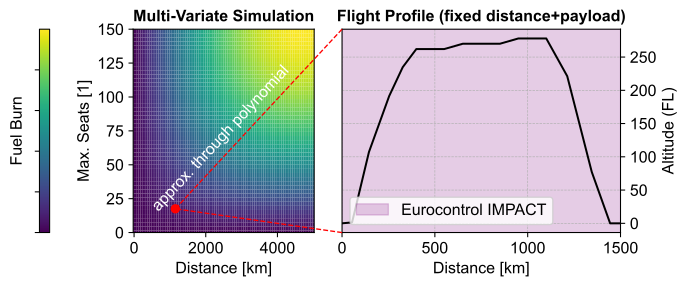
This class implements the reduced-order fuel burn model of Montlaur et al. (2025):
Montlaur et al. Visual Abstract

In this model, fuel burn calculations are based on a regression model. The regression coefficients were obtained by fitting mission parameters to fuel burn data obtained from the Eurocontrol IMPACT model.

Fuel burn is calculated according to the function compute_fuel_ask() in the code supplement to Montlaur et al. (2025):

\[ F/ASK = \beta_0 + \frac{\beta_1}{D} + \beta_2 D + \beta_3 S + \beta_4 (D \cdot S) \]

where:

Symbol Unit Description
\(F/ASK\) [mass] / ([length] \(\cdot\) [seats]) Fuel per Available Seat Kilometer
\(D\) [length] Flight distance
\(S\) [dimensionless] Number of available seats
\(\beta_{0-4}\) varies Regression coefficients
References

Montlaur, A., Trapote-Barreira, C., & Delgado, L. (2025). Analytical models of flight fuel consumption and Non-CO2 emissions as a function of aircraft capacity. Applied Sciences, 15(17), 9688. doi:10.3390/app15179688

Montlaur, A., Delgado, L., & Trapote-Barreira, C. (2021). Analytical models for CO2 emissions and travel time for short-to-medium-haul flights considering available seats. Sustainability, 13(18), 10401. doi:10.3390/su131810401

See Also

emissions_fuel_estimation.emissions_fuel_model.compute_fuel_ask()

Notes

The model differentiates between "Small Aircraft" and "Large Aircraft" based on seat capacity and flight distance, as defined in Table 1 of Montlaur et al. (2020):

Model Designation Seat Capacity (\(S\)) Flight Distance (\(D\)) Representative Aircraft
"Model D, E" \(50 \le S \le 172\) \(100 \le D \le 5000\) km CAT D: B38M, A319
CAT E: CRJ2, CRJ9, E190
"Model B, D" \(172 \le S \le 350\) \(200 \le D \le 12000\) km CAT B: A359, A339, B77W, B788, B789
CAT D: A21N, A20N, B38M
Example

Editor (session: default) Run
import jetfuelburn
from jetfuelburn import ureg
from jetfuelburn.reducedorder import montlaur_etal
result = montlaur_etal.calculate_fuel_consumption(
    distance=1500 * ureg.km,
    available_seats=180,
)
Output Clear
Source code in jetfuelburn/reducedorder.py
class montlaur_etal:
    r"""
    This class implements the reduced-order fuel burn model of Montlaur et al. (2025):

    ![Montlaur et al. Visual Abstract](../_static/reduced_order_montlaur_etal.svg)

    In this model, fuel burn calculations are based on a regression model.
    The regression coefficients were obtained by fitting mission parameters to fuel burn data obtained
    from the Eurocontrol IMPACT model.

    Fuel burn is calculated according to the function `compute_fuel_ask()` in [the code supplement](https://github.com/luis-uow/emissions_fuel_estimation)
    to Montlaur et al. (2025):

    $$
        F/ASK = \beta_0 + \frac{\beta_1}{D} + \beta_2 D + \beta_3 S + \beta_4 (D \cdot S)
    $$

    where:

    | Symbol         | Unit                                | Description                                                    |
    |----------------|-------------------------------------|----------------------------------------------------------------|
    | $F/ASK$        | [mass] / ([length] $\cdot$ [seats]) | Fuel per Available Seat Kilometer                              |
    | $D$            | [length]                            | Flight distance                                                |
    | $S$            | [dimensionless]                     | Number of available seats                                      |
    | $\beta_{0-4}$  | varies                              | Regression coefficients                                        |

    References
    ----------
    Montlaur, A., Trapote-Barreira, C., & Delgado, L. (2025).
    Analytical models of flight fuel consumption and Non-CO2 emissions as a function of aircraft capacity.
    _Applied Sciences_, 15(17), 9688.
    doi:[10.3390/app15179688](https://doi.org/10.3390/app15179688)

    Montlaur, A., Delgado, L., & Trapote-Barreira, C. (2021).
    Analytical models for CO2 emissions and travel time for short-to-medium-haul flights considering available seats.
    _Sustainability_, 13(18), 10401.
    doi:[10.3390/su131810401](https://doi.org/10.3390/su131810401)

    See Also
    --------
    [`emissions_fuel_estimation.emissions_fuel_model.compute_fuel_ask()`](https://github.com/luis-uow/emissions_fuel_estimation/blob/6d415b38e6089f29ff46a86646db0d5cc04744ba/emissions_fuel_model.py#L9)

    Notes
    -----
    The model differentiates between "Small Aircraft" and "Large Aircraft" based on seat capacity and flight distance,
    as defined in Table 1 of Montlaur et al. (2020):

    | Model Designation | Seat Capacity ($S$)         | Flight Distance ($D$)         | Representative Aircraft                                              |
    |-------------------|-----------------------------|-------------------------------|------------------------------------------------------------------------|
    | "Model D, E"      | $50 \le S \le 172$          | $100 \le D \le 5000$ km       | **CAT D:** B38M, A319<br>**CAT E:** CRJ2, CRJ9, E190                  |
    | "Model B, D"      | $172 \le S \le 350$         | $200 \le D \le 12000$ km      | **CAT B:** A359, A339, B77W, B788, B789<br>**CAT D:** A21N, A20N, B38M |

    Example
    -------
    ```pyodide install='jetfuelburn'
    import jetfuelburn
    from jetfuelburn import ureg
    from jetfuelburn.reducedorder import montlaur_etal
    result = montlaur_etal.calculate_fuel_consumption(
        distance=1500 * ureg.km,
        available_seats=180,
    )
    ```
    """

    _REGRESSION_COEFFICIENTS_MODEL_D_E = {
        "intercept": 34.67 * ureg("dimensionless"),
        "inv_dist": 6608.0 * ureg("km"),
        "dist": -1.196e-3 / ureg("km"),
        "seats": -0.1354 * ureg("dimensionless"),
        "interaction": 1.338e-5 / ureg("km"),
    }

    _REGRESSION_COEFFICIENTS_MODEL_B_D = {
        "intercept": 0.7361 * ureg("dimensionless"),
        "inv_dist": 6651.0 * ureg("km"),
        "dist": 5.989e-4 / ureg("km"),
        "seats": 6.152e-2 * ureg("dimensionless"),
        "interaction": -1.014e-6 / ureg("km"),
    }

    @staticmethod
    @ureg.check("[length]", None, None)
    def calculate_fuel_consumption(
        distance: float,
        available_seats: int,
        model: str = "",
    ) -> ureg.Quantity:
        """
        Calculates the estimated fuel consumption per Available Seat Kilometer.

        Parameters
        ----------
        distance : float
            Flight distance [length]
        available_seats : int
            Number of available seats
        model : str, optional
            Model designation to use: `B_D` for large aircraft, `D_E` for small aircraft.
            If left blank, the model will auto-select based on available seats and distance.
            Default is "" (auto-select).

        Returns
        -------
        ureg.Quantity
            Estimated fuel consumption [mass/length]

        Raises
        ------
        ValueError
            If inputs are outside the valid operational bounds and model designation is invalid.
        """
        d_km = distance.to("km")

        if not (50 <= available_seats <= 365):
            raise ValueError(
                f"Seats available {available_seats} out of range (50 - 365)."
            )
        if not (100 * ureg.km <= d_km <= 12000 * ureg.km):
            raise ValueError(f"Distance {d_km} out of range (100 - 12,000 km).")
        if d_km > 5000 * ureg.km and available_seats < 172:
            raise ValueError("Flights over 5,000 km require at least 172 seats.")
        if available_seats >= 172 and d_km < 200 * ureg.km:
            raise ValueError(
                "Flights under 200 km are invalid for aircraft with 172+ seats."
            )
        if model not in ("B_D", "D_E") and model != "":
            raise ValueError(
                f"Model '{model}' is not recognized. Use 'B_D', 'D_E', or leave blank for auto-selection based on available seats and distance."
            )

        if model == "":
            if (
                172 <= available_seats <= 365
                and 200 * ureg.km <= d_km <= 12000 * ureg.km
            ):
                model = "B_D"
            else:
                model = "D_E"

        beta: dict = (
            montlaur_etal._REGRESSION_COEFFICIENTS_MODEL_B_D
            if model == "B_D"
            else montlaur_etal._REGRESSION_COEFFICIENTS_MODEL_D_E
        )

        # Fuel/ASK = b0 + b1/D + b2*D + b3*S + b4*D*S
        fuel_ask_value = (
            beta["intercept"]
            + (beta["inv_dist"] / d_km)
            + (beta["dist"] * d_km)
            + (beta["seats"] * available_seats)
            + (beta["interaction"] * d_km * available_seats)
        )

        return fuel_ask_value * ureg("gram / km")

calculate_fuel_consumption staticmethod

calculate_fuel_consumption(
    distance, available_seats, model=""
)

Calculates the estimated fuel consumption per Available Seat Kilometer.

Parameters:

Name Type Description Default
distance float

Flight distance [length]

required
available_seats int

Number of available seats

required
model str

Model designation to use: B_D for large aircraft, D_E for small aircraft. If left blank, the model will auto-select based on available seats and distance. Default is "" (auto-select).

''

Returns:

Type Description
Quantity

Estimated fuel consumption [mass/length]

Raises:

Type Description
ValueError

If inputs are outside the valid operational bounds and model designation is invalid.

Source code in jetfuelburn/reducedorder.py
@staticmethod
@ureg.check("[length]", None, None)
def calculate_fuel_consumption(
    distance: float,
    available_seats: int,
    model: str = "",
) -> ureg.Quantity:
    """
    Calculates the estimated fuel consumption per Available Seat Kilometer.

    Parameters
    ----------
    distance : float
        Flight distance [length]
    available_seats : int
        Number of available seats
    model : str, optional
        Model designation to use: `B_D` for large aircraft, `D_E` for small aircraft.
        If left blank, the model will auto-select based on available seats and distance.
        Default is "" (auto-select).

    Returns
    -------
    ureg.Quantity
        Estimated fuel consumption [mass/length]

    Raises
    ------
    ValueError
        If inputs are outside the valid operational bounds and model designation is invalid.
    """
    d_km = distance.to("km")

    if not (50 <= available_seats <= 365):
        raise ValueError(
            f"Seats available {available_seats} out of range (50 - 365)."
        )
    if not (100 * ureg.km <= d_km <= 12000 * ureg.km):
        raise ValueError(f"Distance {d_km} out of range (100 - 12,000 km).")
    if d_km > 5000 * ureg.km and available_seats < 172:
        raise ValueError("Flights over 5,000 km require at least 172 seats.")
    if available_seats >= 172 and d_km < 200 * ureg.km:
        raise ValueError(
            "Flights under 200 km are invalid for aircraft with 172+ seats."
        )
    if model not in ("B_D", "D_E") and model != "":
        raise ValueError(
            f"Model '{model}' is not recognized. Use 'B_D', 'D_E', or leave blank for auto-selection based on available seats and distance."
        )

    if model == "":
        if (
            172 <= available_seats <= 365
            and 200 * ureg.km <= d_km <= 12000 * ureg.km
        ):
            model = "B_D"
        else:
            model = "D_E"

    beta: dict = (
        montlaur_etal._REGRESSION_COEFFICIENTS_MODEL_B_D
        if model == "B_D"
        else montlaur_etal._REGRESSION_COEFFICIENTS_MODEL_D_E
    )

    # Fuel/ASK = b0 + b1/D + b2*D + b3*S + b4*D*S
    fuel_ask_value = (
        beta["intercept"]
        + (beta["inv_dist"] / d_km)
        + (beta["dist"] * d_km)
        + (beta["seats"] * available_seats)
        + (beta["interaction"] * d_km * available_seats)
    )

    return fuel_ask_value * ureg("gram / km")

myclimate

This class implements the public part of the myClimate Flight Emissions Calculator.

Fuel burn is calculated using a quadratic function of the form defined in the myClimate Flight Emissions Calculator Calculation Principles:

\[ f(x) + LTO = ax^2 + bx + c \]

where:

Symbol Dimension Description
\(f(x)\) [mass] Fuel consumption (cruise) in kg
\(LTO\) [mass] Fuel consumption (landing-takeoff-cycle (LTO)) in kg
\(x\) [distance] Distance in km
\(a\) [mass] Coefficient of the quadratic term
\(b\) [mass] Coefficient of the linear term
\(c\) [mass] Coefficient of the constant term
Notes

As of early 2025, the myClimate calculator offers a selection of 10 specific aircraft types. For 4 of these, specific parameters are provided on the Flight Emissions Calculator Calculation Principles page:

Size Category Range [km] # of Seats
"standard short-haul" \(<1500km\) 157.86
"standard long-haul" \(>2500km\) 302.58
B737 not provided 148.00
A320 not provided 165.00
A330 not provided 287.00
B777 not provided 370.00

Key assumptions of this fuel calculation function:

Parameter Assumption
data availability N/A, fleet-average values only
aircraft payload average
climb/descent considered in "LTO" factor, which is not made public
fuel reserves not considered explicitly
alternate airport not considered explicitly
References

myClimate Flight Emissions Calculator Calculation Principles

Example

Editor (session: default) Run
import jetfuelburn
from jetfuelburn import ureg
from jetfuelburn.reducedorder import myclimate
myclimate.available_aircraft()[0:10]
myclimate.calculate_fuel_consumption(
    acft='B737',
    x=2200*ureg.km,
)
Output Clear
Source code in jetfuelburn/reducedorder.py
class myclimate:
    r"""
    This class implements the public part of the myClimate Flight Emissions Calculator.

    Fuel burn is calculated using a quadratic function of the form
    defined in the myClimate Flight Emissions Calculator Calculation Principles:

    $$
    f(x) + LTO = ax^2 + bx + c
    $$

    where:

    | Symbol     | Dimension         | Description                                                            |
    |------------|-------------------|------------------------------------------------------------------------|
    | $f(x)$     | [mass]            | Fuel consumption (cruise) in kg                                        |
    | $LTO$      | [mass]            | Fuel consumption (landing-takeoff-cycle (LTO)) in kg                   |
    | $x$        | [distance]        | Distance in km                                                         |
    | $a$        | [mass]            | Coefficient of the quadratic term                                      |
    | $b$        | [mass]            | Coefficient of the linear term                                         |
    | $c$        | [mass]            | Coefficient of the constant term                                       |

    Notes
    -----
    As of early 2025, the myClimate calculator offers a selection of 10 specific aircraft types.
    For 4 of these, specific parameters are provided on the Flight Emissions Calculator Calculation Principles page:

    | Size Category         | Range [km]    | # of Seats         |
    |-----------------------|---------------|--------------------|
    | "standard short-haul" | $<1500km$     | 157.86             |
    | "standard long-haul"  | $>2500km$     | 302.58             |
    | B737                  | not provided  | 148.00             |
    | A320                  | not provided  | 165.00             |
    | A330                  | not provided  | 287.00             |
    | B777                  | not provided  | 370.00             |

    Key assumptions of this fuel calculation function:

    | Parameter         | Assumption                                                                 |
    |-------------------|----------------------------------------------------------------------------|
    | data availability | N/A, fleet-average values only                                             |
    | aircraft payload  | average                                                                    |
    | climb/descent     | considered in "LTO" factor, which is not made public                       |
    | fuel reserves     | not considered explicitly                                                  |
    | alternate airport | not considered explicitly                                                  |

    References
    ----------
    [myClimate Flight Emissions Calculator Calculation Principles](https://www.myclimate.org/en/information/about-myclimate/downloads/flight-emission-calculator/)

    Example
    -------
    ```pyodide install='jetfuelburn'
    import jetfuelburn
    from jetfuelburn import ureg
    from jetfuelburn.reducedorder import myclimate
    myclimate.available_aircraft()[0:10]
    myclimate.calculate_fuel_consumption(
        acft='B737',
        x=2200*ureg.km,
    )
    ```
    """

    _regression_coefficients = {
        "A320": {"a": 0.00016, "b": 1.454, "c": 1531.722},
        "B737": {"a": 0.000032, "b": 2.588, "c": 1212.084},
        "A330": {"a": 0.00034, "b": 4.384, "c": 2457.737},
        "B777": {"a": 0.00034, "b": 6.112, "c": 3403.041},
        "standard aircraft": {},
    }

    @staticmethod
    def available_aircraft() -> list[str]:
        """
        Returns a sorted list of available ICAO aircraft designators included in the model.
        """
        return sorted(myclimate._regression_coefficients.keys())

    @staticmethod
    @ureg.check(
        None,  # acft
        "[length]",
    )
    def calculate_fuel_consumption(
        acft: str,
        x: float,
    ) -> float:
        r"""
        Given a flight distance, calculate the fleet-average fuel consumption of a flight using the
        [myClimate Flight Emissions Calculator](https://co2.myclimate.org/en/flight_calculators/new).

        Warnings
        --------
        It is not entirely clear from the description of the myClimate Flight Emissions Calculator
        how distances of <1500km for short-haul aircraft and distances of >2500km for long-haul aircraft
        are handled. [The description](https://www.myclimate.org/en/information/about-myclimate/downloads/flight-emission-calculator/) mentions that

        > "The fuel consumption for distances between 1500 and 2500 km is linearly interpolated."

        but this would make sense only for the "standard short-haul" and "standard long-haul" aircraft?

        In this function, short-haul aircraft can therefore only be used for distances of <1500km
        and long-haul aircraft can only be used for distances of >2500km. The `standard aircraft` option
        can be used for all distances.

        Parameters
        ----------
        x : float
            Mission distance [length].

        Returns
        -------
        float
            Fuel consumption [mass] in kg.
        """
        if x < (0 * ureg.km):
            raise ValueError("Distance must not be negative.")
        x = x.to("km").magnitude

        if acft in ["A320", "B737"] and x > 2500:
            raise ValueError(f"Aircraft {acft} is not valid for distances > 2500 km.")
        if acft in ["A330", "B777"] and x < 1500:
            raise ValueError(f"Aircraft {acft} is not valid for distances < 1500 km.")

        if acft == "standard aircraft":
            if x < 1500:
                a = 0.000007
                b = 2.775
                c = 1260.608
            elif x < 2500:
                a = 0.000007 + 0.000283 * (x - 1500) / 1000
                b = 2.775 + 0.7 * (x - 1500) / 1000
                c = 1260.608 + 1999.083 * (x - 1500) / 1000
            elif x >= 2500:
                a = 0.00029
                b = 3.475
                c = 3259.691
        else:
            a = myclimate._regression_coefficients[acft]["a"]
            b = myclimate._regression_coefficients[acft]["b"]
            c = myclimate._regression_coefficients[acft]["c"]

        return (a * x**2 + b * x + c) * ureg.kg

available_aircraft staticmethod

available_aircraft()

Returns a sorted list of available ICAO aircraft designators included in the model.

Source code in jetfuelburn/reducedorder.py
@staticmethod
def available_aircraft() -> list[str]:
    """
    Returns a sorted list of available ICAO aircraft designators included in the model.
    """
    return sorted(myclimate._regression_coefficients.keys())

calculate_fuel_consumption staticmethod

calculate_fuel_consumption(acft, x)

Given a flight distance, calculate the fleet-average fuel consumption of a flight using the myClimate Flight Emissions Calculator.

Warnings

It is not entirely clear from the description of the myClimate Flight Emissions Calculator how distances of <1500km for short-haul aircraft and distances of >2500km for long-haul aircraft are handled. The description mentions that

"The fuel consumption for distances between 1500 and 2500 km is linearly interpolated."

but this would make sense only for the "standard short-haul" and "standard long-haul" aircraft?

In this function, short-haul aircraft can therefore only be used for distances of <1500km and long-haul aircraft can only be used for distances of >2500km. The standard aircraft option can be used for all distances.

Parameters:

Name Type Description Default
x float

Mission distance [length].

required

Returns:

Type Description
float

Fuel consumption [mass] in kg.

Source code in jetfuelburn/reducedorder.py
@staticmethod
@ureg.check(
    None,  # acft
    "[length]",
)
def calculate_fuel_consumption(
    acft: str,
    x: float,
) -> float:
    r"""
    Given a flight distance, calculate the fleet-average fuel consumption of a flight using the
    [myClimate Flight Emissions Calculator](https://co2.myclimate.org/en/flight_calculators/new).

    Warnings
    --------
    It is not entirely clear from the description of the myClimate Flight Emissions Calculator
    how distances of <1500km for short-haul aircraft and distances of >2500km for long-haul aircraft
    are handled. [The description](https://www.myclimate.org/en/information/about-myclimate/downloads/flight-emission-calculator/) mentions that

    > "The fuel consumption for distances between 1500 and 2500 km is linearly interpolated."

    but this would make sense only for the "standard short-haul" and "standard long-haul" aircraft?

    In this function, short-haul aircraft can therefore only be used for distances of <1500km
    and long-haul aircraft can only be used for distances of >2500km. The `standard aircraft` option
    can be used for all distances.

    Parameters
    ----------
    x : float
        Mission distance [length].

    Returns
    -------
    float
        Fuel consumption [mass] in kg.
    """
    if x < (0 * ureg.km):
        raise ValueError("Distance must not be negative.")
    x = x.to("km").magnitude

    if acft in ["A320", "B737"] and x > 2500:
        raise ValueError(f"Aircraft {acft} is not valid for distances > 2500 km.")
    if acft in ["A330", "B777"] and x < 1500:
        raise ValueError(f"Aircraft {acft} is not valid for distances < 1500 km.")

    if acft == "standard aircraft":
        if x < 1500:
            a = 0.000007
            b = 2.775
            c = 1260.608
        elif x < 2500:
            a = 0.000007 + 0.000283 * (x - 1500) / 1000
            b = 2.775 + 0.7 * (x - 1500) / 1000
            c = 1260.608 + 1999.083 * (x - 1500) / 1000
        elif x >= 2500:
            a = 0.00029
            b = 3.475
            c = 3259.691
    else:
        a = myclimate._regression_coefficients[acft]["a"]
        b = myclimate._regression_coefficients[acft]["b"]
        c = myclimate._regression_coefficients[acft]["c"]

    return (a * x**2 + b * x + c) * ureg.kg

sacchi_etal

This class implements the reduced-order fuel burn model of Sacchi et al. (2023):
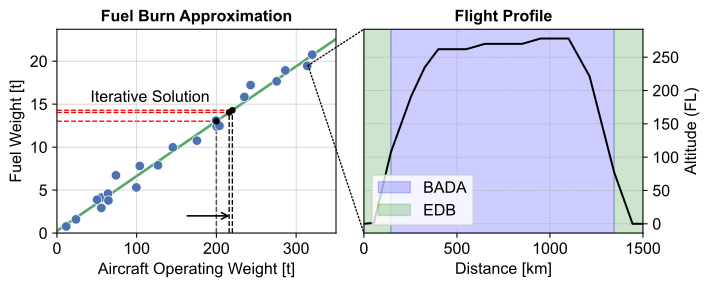
Sacchi et al. Visual Abstract

In this model, fuel burn calculations are based on a weight-based power law. The regression coefficients were obtained by fitting mission parameters to fuel burn data obtained from the European Environmental Agency EMEP/EEA air pollutant emission inventory guidebook - 2013 which in turn is based on a combination of Eurocontrol BADA flight trajectory simulation model data and the ICAO Engine Emissions Databank (EDB). Cruise segment fuel burn is calculated using the Eurocontrol BADA model. Climb and descent segment fuel burn is calculated using the values provided in the ICAO Engine Emissions Databank.

Fuel burn is calculated according to Supplement 1 of Sacchi et al. (2023):

\[ F_{total} = \eta(t) \cdot \left( \underbrace{a_{LTO} \cdot W^{b_{LTO}}}_{\text{LTO}} + \underbrace{a_{CD} \cdot W^{b_{CD}}}_{\text{Climb/Descent}} + \underbrace{(a_{cruise} \cdot W^{b_{cruise}} + c_{cruise}) \cdot R}_{\text{cruise}} \right) \]

where:

Symbol Dimension Description
\(F_{total}\) [mass] Total fuel consumption of the flight
\(W\) [mass] Operating empty weight of the aircraft
\(R\) [length] Range of the aircraft (=mission distance)
\(t\) [time] Scenario year
\(a_{LTO}\) Coefficient 'a' for LTO phase
\(b_{LTO}\) Exponent 'b' for LTO phase
\(a_{CD}\) Coefficient 'a' for Climb/Descent phase
\(b_{CD}\) Exponent 'b' for Climb/Descent phase
\(a_{cruise}\) Coefficient 'a' for Cruise phase
\(b_{cruise}\) Exponent 'b' for Cruise phase
\(c_{cruise}\) Constant 'c' for Cruise phase (fuel per km)
\(r_{hist}\) [dimensionless] Historical annual improvement rate (2004-2018)
\(r_{fut}\) [dimensionless] Future annual improvement rate (post-2018)

Efficiency \(\eta(t)\) for years after 2018 is defined through two constant annual improvement factors for the periods 2004-2018 and post-2018:

\[ \eta(t) = (1 + r_{hist})^{14} \cdot (1 + r_{fut})^{(t - 2018)} \]

where:

Symbol Dimension Description
\(\eta(t)\) [dimensionless] Efficiency improvement over 2004 baseline
\(r_{hist}\) [dimensionless] Historical annual improvement rate (2004-2018)
\(r_{fut}\) [dimensionless] Projected future annual improvement rate (post-2018)
\(t\) [time] Scenario year (>=2018)

Annual Improvement Plot

Operating empty weight (OEW) is calculated as a function of maximum passenger capacity:
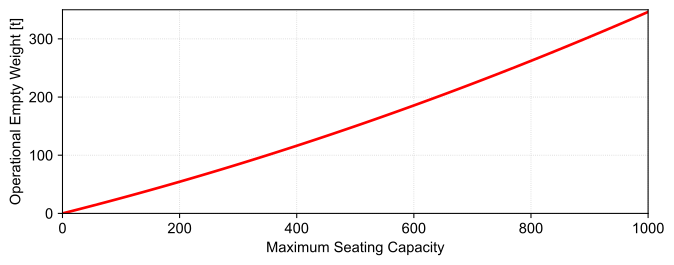
\[ OEW = \left(0.0927 \cdot pax_{max}^2 + 253.6 \cdot pax_{max} \cdot (1 - 0.00174)^{(t - 2004)}\right) \; [kg] \]

Weight Approximation

Notes

Key assumptions of this fuel calculation function:

Parameter Assumption
data availability approximation of aircraft operating empty weight as a function of max passengers
aircraft payload variable
climb/descent considered implicitly
reserve fuel uplift 45 min for long-haul flights assumed
diversion fuel uplift not considered
Refences

Sacchi, R., Becattini, V., Gabrielli, P., Cox, B., Dirnaichner, A., Bauer, C., & Mazzotti, M. (2023). How to make climate-neutral aviation fly. Nature Communications. doi:10.1038/s41467-023-39749-y

See Also

Cell DM8 in Supplement 1 of Sacchi et al. (2020) for fuel burn in cruise. Cell CQ8 in Supplement 1 of Sacchi et al. (2020) for fuel burn in climb/descent. Cell BU8 in Supplement 1 of Sacchi et al. (2020) for fuel burn in takeoff/landing. Cell BP8 in Supplement 1 of Sacchi et al. (2020) for OEW as a function of max passengers.

Example

Editor (session: default) Run
import jetfuelburn
from jetfuelburn import ureg
from jetfuelburn.reducedorder import sacchi_etal
sacchi_etal.calculate_fuel_consumption(
    year=2025,
    pax_max=180,
    pax=150,
    R=2200*ureg.km
)
Output Clear
Source code in jetfuelburn/reducedorder.py
class sacchi_etal:
    r"""
    This class implements the reduced-order fuel burn model of Sacchi et al. (2023):

    ![Sacchi et al. Visual Abstract](../_static/reduced_order_sacchi.svg)

    In this model, fuel burn calculations are based on a weight-based power law.
    The regression coefficients were obtained by fitting mission parameters to fuel burn data obtained
    from the European Environmental Agency [EMEP/EEA air pollutant emission inventory guidebook - 2013](https://www.eea.europa.eu/en/analysis/publications/emep-eea-guidebook-2013)
    which in turn is based on a combination of Eurocontrol BADA flight trajectory simulation model data and the ICAO Engine Emissions Databank (EDB).
    Cruise segment fuel burn is calculated using the [Eurocontrol BADA](https://www.eurocontrol.int/model/bada) model.
    Climb and descent segment fuel burn is calculated using the values provided in the ICAO Engine Emissions Databank.

    Fuel burn is calculated according to Supplement 1 of Sacchi et al. (2023):

    $$
        F_{total} = \eta(t) \cdot \left(
        \underbrace{a_{LTO} \cdot W^{b_{LTO}}}_{\text{LTO}} +
        \underbrace{a_{CD} \cdot W^{b_{CD}}}_{\text{Climb/Descent}} +
        \underbrace{(a_{cruise} \cdot W^{b_{cruise}} + c_{cruise}) \cdot R}_{\text{cruise}}
        \right)
    $$

    where:

    | Symbol         | Dimension         | Description                                                            |
    |----------------|-------------------|------------------------------------------------------------------------|
    | $F_{total}$    | [mass]            | Total fuel consumption of the flight                                   |
    | $W$            | [mass]            | Operating empty weight of the aircraft                                 |
    | $R$            | [length]          | Range of the aircraft (=mission distance)                              |
    | $t$            | [time]            | Scenario year                                                          |
    | $a_{LTO}$      |                   | Coefficient 'a' for LTO phase                                          |
    | $b_{LTO}$      |                   | Exponent 'b' for LTO phase                                             |
    | $a_{CD}$       |                   | Coefficient 'a' for Climb/Descent phase                                |
    | $b_{CD}$       |                   | Exponent 'b' for Climb/Descent phase                                   |
    | $a_{cruise}$   |                   | Coefficient 'a' for Cruise phase                                     |
    | $b_{cruise}$   |                   | Exponent 'b' for Cruise phase                                          |
    | $c_{cruise}$   |                   | Constant 'c' for Cruise phase (fuel per km)                            |
    | $r_{hist}$     | [dimensionless]   | Historical annual improvement rate (2004-2018)                         |
    | $r_{fut}$      | [dimensionless]   | Future annual improvement rate (post-2018)                             |

    Efficiency $\eta(t)$ for years after 2018 is defined through two constant annual improvement factors for the periods 2004-2018 and post-2018:

    $$
        \eta(t) = (1 + r_{hist})^{14} \cdot (1 + r_{fut})^{(t - 2018)}
    $$

    where:

    | Symbol         | Dimension         | Description                                                            |
    |----------------|-------------------|------------------------------------------------------------------------|
    | $\eta(t)$      | [dimensionless]   | Efficiency improvement over 2004 baseline                              |
    | $r_{hist}$     | [dimensionless]   | Historical annual improvement rate (2004-2018)                         |
    | $r_{fut}$      | [dimensionless]   | Projected future annual improvement rate (post-2018)                   |
    | $t$            | [time]            | Scenario year (>=2018)                                                 |

    ![Annual Improvement Plot](../_static/reduced_order_sacchi_improvement.svg)

    Operating empty weight (OEW) is calculated as a function of maximum passenger capacity:

    $$
    OEW = \left(0.0927 \cdot pax_{max}^2 + 253.6 \cdot pax_{max} \cdot (1 - 0.00174)^{(t - 2004)}\right) \; [kg]
    $$

    ![Weight Approximation](../_static/reduced_order_sacchi_weight.svg)

    Notes
    -----
    Key assumptions of this fuel calculation function:

    | Parameter             | Assumption                                                                       |
    |-----------------------|----------------------------------------------------------------------------------|
    | data availability     | approximation of aircraft operating empty weight as a function of max passengers |
    | aircraft payload      | variable                                                                         |
    | climb/descent         | considered implicitly                                                            |
    | reserve fuel uplift   | 45 min for long-haul flights assumed                                             |
    | diversion fuel uplift | not considered                                                                   |

    Refences
    --------
    Sacchi, R., Becattini, V., Gabrielli, P., Cox, B., Dirnaichner, A., Bauer, C., & Mazzotti, M. (2023).
    How to make climate-neutral aviation fly. _Nature Communications_. doi:[10.1038/s41467-023-39749-y](https://doi.org/10.1038/s41467-023-39749-y)

    See Also
    --------
    Cell `DM8` in [Supplement 1 of Sacchi et al. (2020)](https://doi.org/10.5281/zenodo.8059750) for fuel burn in cruise.
    Cell `CQ8` in [Supplement 1 of Sacchi et al. (2020)](https://doi.org/10.5281/zenodo.8059750) for fuel burn in climb/descent.
    Cell `BU8` in [Supplement 1 of Sacchi et al. (2020)](https://doi.org/10.5281/zenodo.8059750) for fuel burn in takeoff/landing.
    Cell `BP8` in [Supplement 1 of Sacchi et al. (2020)](https://doi.org/10.5281/zenodo.8059750) for OEW as a function of max passengers.

    Example
    -------
    ```pyodide install='jetfuelburn'
    import jetfuelburn
    from jetfuelburn import ureg
    from jetfuelburn.reducedorder import sacchi_etal
    sacchi_etal.calculate_fuel_consumption(
        year=2025,
        pax_max=180,
        pax=150,
        R=2200*ureg.km
    )
    ```
    """

    coefficients_LTO = {
        "a": 0.09047379 * (ureg.kg ** (1 - 0.850276476)),
        "b": 0.850276476,  # Dimensionless exponent
    }

    coefficients_CD = {
        "a": 1.144010778 * (ureg.kg ** (1 - 0.5374018)),
        "b": 0.5374018,  # Dimensionless exponent
    }

    coefficients_cruise = {
        "a": 5.8583e-05 * (ureg.kg ** (1 - 0.976183654)) / ureg.km,
        "b": 0.976183654,  # Dimensionless exponent
        "c": 0.783563064 * ureg.kg / ureg.km,
    }
    historical_improvement_rate = -0.006
    future_improvement_rate = -0.008

    @staticmethod
    @ureg.check(None, "[mass]", "[length]")  # year  # TOW  # R
    def _calculate_single_pass(
        year: int,
        TOW: float,
        R: float,
    ) -> float:
        """
        Helper function to calculate fuel for a specific given takeoff weight $TOW$ (including fuel).
        """
        if year < 2018:
            raise ValueError("Year must be 2018 or later.")

        eff_factor_hist = (1 + sacchi_etal.historical_improvement_rate) ** (2018 - 2004)
        years_post_2018 = year - 2018
        eff_factor_future = (1 + sacchi_etal.future_improvement_rate) ** years_post_2018
        total_efficiency_factor = eff_factor_hist * eff_factor_future

        lto_fuel_base = sacchi_etal.coefficients_LTO["a"] * (
            TOW ** sacchi_etal.coefficients_LTO["b"]
        )
        cd_fuel_base = sacchi_etal.coefficients_CD["a"] * (
            TOW ** sacchi_etal.coefficients_CD["b"]
        )
        cruise_rate_per_km = (
            sacchi_etal.coefficients_cruise["a"]
            * (TOW ** sacchi_etal.coefficients_cruise["b"])
            + sacchi_etal.coefficients_cruise["c"]
        )
        cruise_fuel_base = cruise_rate_per_km * R

        return (
            lto_fuel_base + cd_fuel_base + cruise_fuel_base
        ) * total_efficiency_factor

    @classmethod
    @ureg.check(
        None,  # cls
        None,  # year
        None,  # pax_max
        None,  # pax
        "[length]",  # R
        "[time]",  # reserve
        "[mass]",  # tolerance
        None,  # max_iterations
    )
    def calculate_fuel_consumption(
        cls,
        year: int,
        pax_max: int,
        pax: int,
        R: float,
        reserve: float = 45 * ureg("min"),
        tolerance: float = 100 * ureg("kg"),
        max_iterations: int = 20,
    ) -> float:
        """
        Calculates the required fuel mass iteratively.

        Since Fuel depends on Take-Off Weight (TOW), and TOW includes Fuel,
        this method iterates until the fuel mass converges.

        Parameters
        ----------
        year : int
            Scenario year (>=2018).
        pax_max : int
            Maximum passenger capacity of the aircraft.
        pax : int
            Number of passengers on board (assumed to weigh 110kg incl. luggage each).
        R : float
            Mission range [length].
        tolerance : float, optional
            Convergence tolerance for fuel mass [mass]. Default is 100 kg.
        max_iterations : int, optional
            Maximum number of iterations. Default is 20.

        Returns
        -------
        float
            Total fuel mass [kg].
        """
        if year < 2018:
            raise ValueError("Year must be 2018 or later.")
        if pax < 0 or pax > pax_max:
            raise ValueError(
                f"Number of passengers must be between 0 and maximum pax {pax_max}."
            )

        OEW = (
            0.0927 * pax_max**2 + 253.6 * pax_max * (1 - 0.00174) ** (year - 2004)
        ) * ureg("kg")
        payload = pax * 110 * ureg("kg")
        R = R.to("km") + reserve.to("hr") * 800 * ureg(
            "km/hr"
        )  # add reserve distance (assuming 800km/h cruise speed)

        fuel_guess = 0.0 * ureg(
            "kg"
        )  # initial guess: fuel is 0, or a small fraction of weight

        for i in range(max_iterations):
            current_TOW = OEW + payload + fuel_guess

            new_fuel = cls._calculate_single_pass(year, current_TOW, R)

            if abs(new_fuel - fuel_guess) < tolerance:
                return new_fuel

            fuel_guess = new_fuel

        raise RuntimeError(
            f"Fuel calculation did not converge after {max_iterations} iterations."
        )

_calculate_single_pass staticmethod

_calculate_single_pass(year, TOW, R)

Helper function to calculate fuel for a specific given takeoff weight \(TOW\) (including fuel).

Source code in jetfuelburn/reducedorder.py
@staticmethod
@ureg.check(None, "[mass]", "[length]")  # year  # TOW  # R
def _calculate_single_pass(
    year: int,
    TOW: float,
    R: float,
) -> float:
    """
    Helper function to calculate fuel for a specific given takeoff weight $TOW$ (including fuel).
    """
    if year < 2018:
        raise ValueError("Year must be 2018 or later.")

    eff_factor_hist = (1 + sacchi_etal.historical_improvement_rate) ** (2018 - 2004)
    years_post_2018 = year - 2018
    eff_factor_future = (1 + sacchi_etal.future_improvement_rate) ** years_post_2018
    total_efficiency_factor = eff_factor_hist * eff_factor_future

    lto_fuel_base = sacchi_etal.coefficients_LTO["a"] * (
        TOW ** sacchi_etal.coefficients_LTO["b"]
    )
    cd_fuel_base = sacchi_etal.coefficients_CD["a"] * (
        TOW ** sacchi_etal.coefficients_CD["b"]
    )
    cruise_rate_per_km = (
        sacchi_etal.coefficients_cruise["a"]
        * (TOW ** sacchi_etal.coefficients_cruise["b"])
        + sacchi_etal.coefficients_cruise["c"]
    )
    cruise_fuel_base = cruise_rate_per_km * R

    return (
        lto_fuel_base + cd_fuel_base + cruise_fuel_base
    ) * total_efficiency_factor

calculate_fuel_consumption classmethod

calculate_fuel_consumption(
    year,
    pax_max,
    pax,
    R,
    reserve=45 * ureg("min"),
    tolerance=100 * ureg("kg"),
    max_iterations=20,
)

Calculates the required fuel mass iteratively.

Since Fuel depends on Take-Off Weight (TOW), and TOW includes Fuel, this method iterates until the fuel mass converges.

Parameters:

Name Type Description Default
year int

Scenario year (>=2018).

required
pax_max int

Maximum passenger capacity of the aircraft.

required
pax int

Number of passengers on board (assumed to weigh 110kg incl. luggage each).

required
R float

Mission range [length].

required
tolerance float

Convergence tolerance for fuel mass [mass]. Default is 100 kg.

100 * ureg('kg')
max_iterations int

Maximum number of iterations. Default is 20.

20

Returns:

Type Description
float

Total fuel mass [kg].

Source code in jetfuelburn/reducedorder.py
@classmethod
@ureg.check(
    None,  # cls
    None,  # year
    None,  # pax_max
    None,  # pax
    "[length]",  # R
    "[time]",  # reserve
    "[mass]",  # tolerance
    None,  # max_iterations
)
def calculate_fuel_consumption(
    cls,
    year: int,
    pax_max: int,
    pax: int,
    R: float,
    reserve: float = 45 * ureg("min"),
    tolerance: float = 100 * ureg("kg"),
    max_iterations: int = 20,
) -> float:
    """
    Calculates the required fuel mass iteratively.

    Since Fuel depends on Take-Off Weight (TOW), and TOW includes Fuel,
    this method iterates until the fuel mass converges.

    Parameters
    ----------
    year : int
        Scenario year (>=2018).
    pax_max : int
        Maximum passenger capacity of the aircraft.
    pax : int
        Number of passengers on board (assumed to weigh 110kg incl. luggage each).
    R : float
        Mission range [length].
    tolerance : float, optional
        Convergence tolerance for fuel mass [mass]. Default is 100 kg.
    max_iterations : int, optional
        Maximum number of iterations. Default is 20.

    Returns
    -------
    float
        Total fuel mass [kg].
    """
    if year < 2018:
        raise ValueError("Year must be 2018 or later.")
    if pax < 0 or pax > pax_max:
        raise ValueError(
            f"Number of passengers must be between 0 and maximum pax {pax_max}."
        )

    OEW = (
        0.0927 * pax_max**2 + 253.6 * pax_max * (1 - 0.00174) ** (year - 2004)
    ) * ureg("kg")
    payload = pax * 110 * ureg("kg")
    R = R.to("km") + reserve.to("hr") * 800 * ureg(
        "km/hr"
    )  # add reserve distance (assuming 800km/h cruise speed)

    fuel_guess = 0.0 * ureg(
        "kg"
    )  # initial guess: fuel is 0, or a small fraction of weight

    for i in range(max_iterations):
        current_TOW = OEW + payload + fuel_guess

        new_fuel = cls._calculate_single_pass(year, current_TOW, R)

        if abs(new_fuel - fuel_guess) < tolerance:
            return new_fuel

        fuel_guess = new_fuel

    raise RuntimeError(
        f"Fuel calculation did not converge after {max_iterations} iterations."
    )

seymour_etal

Reduced-order fuel burn model based on Seymour et al. (2020).
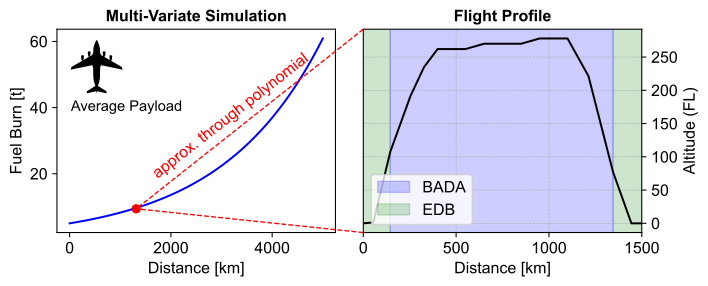
Payload/Range Diagram

In this model, fuel burn calculations are based on a regression model. The regression coefficients were obtained by fitting mission parameters to fuel burn data obtained from the Eurocontrol BADA flight trajectory simulation model and climb/descent fuel burn data based on engine data.

Fuel burn is calculated according to Table M.7 in the supplement to Seymour et al. (2020):

\[ F=a_1 \cdot R^2 + a_2 \cdot R + c \]

where:

Symbol Dimension Description
\(F\) [mass] Fuel required for the mission of the aircraft
\(R\) [distance] Range of the aircraft (=mission distance)
\(a_1\) [mass/distance²] Regression coefficient for range squared
\(a_2\) [mass/distance] Regression coefficient for range
\(c\) [mass] Constant term
Warnings

Note that the regression coefficients provided in Table M.7 of the Supplementary Information of Seymour et al. (2020) are not always consistent with the regression coefficients provided in the GitHub repository. For instance:

reduced_fuel_a1 reduced_fuel_a2 reduced_fuel_intercept
Table M.7 7.13e-05 2.94 1275
GitHub .csv 7.378617475106708e-05 2.920849872328848 1218.8211966548952

This implementation uses the coefficients provided in the GitHub .csv file.

Warnings

Note that Seymour et al. in the Disclaimers section of their publication mention, that:

The fuel burn models provided in (...) [the supplementary information] shall not be used for comparing fuel efficiency and emission data between aircraft models and manufacturers. Recommended model applications are reported in Section 3.5.

Section 3.5 then mentions as potential applications:

(...) computing global CO2 emissions using the reduced order models (...) [and] (...) fleet turnover and flight route projections can be combined to create any number of future flight movement scenarios which together with the reduced order models can be leveraged to generate valuable insights.

Notes

Key assumptions of this fuel calculation function:

Parameter Assumption
data availability 133 selected aircraft
aircraft payload assumed to be average for each aircraft type
climb/descent considered implicitly
reserve fuel uplift considered implicitly, according to ICAO requirements
diversion fuel uplift considered implicitly, according to ICAO requirements
References
  • Seymour, K., Held, M., Georges, G., & Boulouchos, K. (2020). Fuel Estimation in Air Transportation: Modeling global fuel consumption for commercial aviation. Transportation Research Part D: Transport and Environment, 88, 102528. doi:10.1016/j.trd.2020.102528
  • FEAT Model GitHub Repository
Example

Editor (session: default) Run
import jetfuelburn
from jetfuelburn import ureg
from jetfuelburn.reducedorder import seymour_etal
seymour_etal.available_aircraft()[0:10]
seymour_etal.calculate_fuel_consumption(
    acft='A321',
    R=2200*ureg.km,
)
Output Clear
Source code in jetfuelburn/reducedorder.py
class seymour_etal:
    r"""
    Reduced-order fuel burn model based on Seymour et al. (2020).

    ![Payload/Range Diagram](../_static/reduced_order_seymour_etal.svg)

    In this model, fuel burn calculations are based on a regression model.
    The regression coefficients were obtained by fitting mission parameters to fuel burn data obtained
    from the Eurocontrol BADA flight trajectory simulation model and climb/descent fuel burn data based on engine data.

    Fuel burn is calculated according to Table M.7 in the supplement to Seymour et al. (2020):

    $$
        F=a_1 \cdot R^2 + a_2 \cdot R + c
    $$

    where:

    | Symbol     | Dimension            | Description                                   |
    |------------|----------------------|-----------------------------------------------|
    | $F$        | [mass]               | Fuel required for the mission of the aircraft |
    | $R$        | [distance]           | Range of the aircraft (=mission distance)     |
    | $a_1$      | [mass/distance²]     | Regression coefficient for range squared      |
    | $a_2$      | [mass/distance]      | Regression coefficient for range              |
    | $c$        | [mass]               | Constant term                                 |

    Warnings
    --------
    Note that the regression coefficients provided in Table M.7 of the Supplementary Information
    of Seymour et al. (2020) are not always consistent with the regression coefficients provided in the GitHub repository.
    For instance:

    |                   | reduced_fuel_a1       | reduced_fuel_a2   | reduced_fuel_intercept |
    |-------------------|-----------------------|-------------------|------------------------|
    | **Table M.7**     | 7.13e-05              | 2.94              | 1275                   |
    | **GitHub** `.csv` | 7.378617475106708e-05 | 2.920849872328848 | 1218.8211966548952     |

    This implementation uses the coefficients provided in the GitHub `.csv` file.

    Warnings
    --------
    Note that Seymour et al. in the Disclaimers section of their publication mention, that:
    > The fuel burn models provided in (...) [the supplementary information] shall not be used for
    > comparing fuel efficiency and emission data between aircraft models and manufacturers.
    > Recommended model applications are reported in Section 3.5.

    Section 3.5 then mentions as potential applications:
    > (...) computing global CO2 emissions using the reduced order models (...) [and]
    > (...) fleet turnover and flight route projections can be combined to create any
    > number of future flight movement scenarios which together with the reduced order models can be leveraged to generate valuable insights.

    Notes
    -----
    Key assumptions of this fuel calculation function:

    | Parameter             | Assumption                                                                  |
    |-----------------------|-----------------------------------------------------------------------------|
    | data availability     | 133 selected aircraft                                                       |
    | aircraft payload      | assumed to be average for each aircraft type                                |
    | climb/descent         | considered implicitly                                                       |
    | reserve fuel uplift   | considered implicitly, according to ICAO requirements                       |
    | diversion fuel uplift | considered implicitly, according to ICAO requirements                       |

    References
    ----------
    - Seymour, K., Held, M., Georges, G., & Boulouchos, K. (2020).
    Fuel Estimation in Air Transportation: Modeling global fuel consumption for commercial aviation.
    _Transportation Research Part D: Transport and Environment_, 88, 102528.
    doi:[10.1016/j.trd.2020.102528](https://doi.org/10.1016/j.trd.2020.102528)
    - [FEAT Model GitHub Repository](https://github.com/kwdseymour/FEAT/tree/master)

    Example
    -------
    ```pyodide install='jetfuelburn'
    import jetfuelburn
    from jetfuelburn import ureg
    from jetfuelburn.reducedorder import seymour_etal
    seymour_etal.available_aircraft()[0:10]
    seymour_etal.calculate_fuel_consumption(
        acft='A321',
        R=2200*ureg.km,
    )
    ```
    """

    _regression_coefficients = {
        "A140": {
            "reduced_fuel_a1": 0.0001570270040569,
            "reduced_fuel_a2": 1.2982777526024196,
            "reduced_fuel_intercept": 160.62447178027185,
        },
        "A148": {
            "reduced_fuel_a1": 6.398806910579147e-05,
            "reduced_fuel_a2": 1.757267905324482,
            "reduced_fuel_intercept": 971.0358232404124,
        },
        "A158": {
            "reduced_fuel_a1": 3.3362854604312986e-05,
            "reduced_fuel_a2": 2.566018863868268,
            "reduced_fuel_intercept": 799.9393976678402,
        },
        "A20N": {
            "reduced_fuel_a1": 5.668855923612881e-05,
            "reduced_fuel_a2": 2.382220322790334,
            "reduced_fuel_intercept": 955.9771828145858,
        },
        "A21N": {
            "reduced_fuel_a1": 6.322240065870233e-05,
            "reduced_fuel_a2": 2.7236585444593007,
            "reduced_fuel_intercept": 1121.9381760390395,
        },
        "A306": {
            "reduced_fuel_a1": 0.000208303528197,
            "reduced_fuel_a2": 5.292754728665013,
            "reduced_fuel_intercept": 2408.3891219198267,
        },
        "A30B": {
            "reduced_fuel_a1": 0.0001982893815144,
            "reduced_fuel_a2": 6.474756928487186,
            "reduced_fuel_intercept": 2222.798735754448,
        },
        "A310": {
            "reduced_fuel_a1": 0.0001632949648442,
            "reduced_fuel_a2": 4.359746729125529,
            "reduced_fuel_intercept": 2228.0275509617168,
        },
        "A318": {
            "reduced_fuel_a1": 6.89511440921109e-05,
            "reduced_fuel_a2": 2.350075246472605,
            "reduced_fuel_intercept": 1118.9090916083037,
        },
        "A319": {
            "reduced_fuel_a1": 7.861925591479135e-05,
            "reduced_fuel_a2": 2.3082582355790655,
            "reduced_fuel_intercept": 1194.0996838404626,
        },
        "A320": {
            "reduced_fuel_a1": 0.000130042337441,
            "reduced_fuel_a2": 2.4260951197123437,
            "reduced_fuel_intercept": 1310.7950948662055,
        },
        "A321": {
            "reduced_fuel_a1": -5.7378784219075385e-05,
            "reduced_fuel_a2": 4.083572128715679,
            "reduced_fuel_intercept": 1084.1337567410246,
        },
        "A332": {
            "reduced_fuel_a1": 0.0001747859503353,
            "reduced_fuel_a2": 4.9031762660658,
            "reduced_fuel_intercept": 3603.0351976719103,
        },
        "A333": {
            "reduced_fuel_a1": 2.6407166359376788e-05,
            "reduced_fuel_a2": 6.517233690161649,
            "reduced_fuel_intercept": 2090.642673369657,
        },
        "A339": {
            "reduced_fuel_a1": 0.0001769854542406,
            "reduced_fuel_a2": 4.634359445213642,
            "reduced_fuel_intercept": 4057.6671819265466,
        },
        "A342": {
            "reduced_fuel_a1": 0.0002358094393848,
            "reduced_fuel_a2": 5.160351823288175,
            "reduced_fuel_intercept": 4479.616294853418,
        },
        "A343": {
            "reduced_fuel_a1": 0.0002672084309844,
            "reduced_fuel_a2": 5.40202955241821,
            "reduced_fuel_intercept": 3954.7379543269417,
        },
        "A345": {
            "reduced_fuel_a1": 0.0002101950285755,
            "reduced_fuel_a2": 6.852207692367797,
            "reduced_fuel_intercept": 4919.303525652402,
        },
        "A346": {
            "reduced_fuel_a1": 0.0002565271632093,
            "reduced_fuel_a2": 6.86051702890215,
            "reduced_fuel_intercept": 5501.48232695819,
        },
        "A359": {
            "reduced_fuel_a1": 8.61825848810227e-05,
            "reduced_fuel_a2": 6.152636361762516,
            "reduced_fuel_intercept": 1753.6413158785144,
        },
        "A35K": {
            "reduced_fuel_a1": 0.0001846395304374,
            "reduced_fuel_a2": 5.378231075979626,
            "reduced_fuel_intercept": 4413.229547197276,
        },
        "A388": {
            "reduced_fuel_a1": 0.0002976350034167,
            "reduced_fuel_a2": 11.402874182880453,
            "reduced_fuel_intercept": 6408.219743091526,
        },
        "AJ27": {
            "reduced_fuel_a1": 0.0001128545234347,
            "reduced_fuel_a2": 2.220290803974472,
            "reduced_fuel_intercept": 896.880801146056,
        },
        "AN24": {
            "reduced_fuel_a1": 6.1540118558856e-05,
            "reduced_fuel_a2": 1.5981588090902188,
            "reduced_fuel_intercept": 212.2134235255014,
        },
        "AN38": {
            "reduced_fuel_a1": 3.03583389380524e-05,
            "reduced_fuel_a2": 1.50932767352588,
            "reduced_fuel_intercept": 60.10635243403112,
        },
        "AT43": {
            "reduced_fuel_a1": 0.000203974136543,
            "reduced_fuel_a2": 0.7995587234644723,
            "reduced_fuel_intercept": 198.85276266580055,
        },
        "AT72": {
            "reduced_fuel_a1": 0.0002572904328121,
            "reduced_fuel_a2": 1.1306414713636488,
            "reduced_fuel_intercept": 203.17938444650304,
        },
        "ATP": {
            "reduced_fuel_a1": 0.0003809166804082,
            "reduced_fuel_a2": 1.084751679629892,
            "reduced_fuel_intercept": 227.04070386623405,
        },
        "B190": {
            "reduced_fuel_a1": 3.5682877519871425e-05,
            "reduced_fuel_a2": 0.6990438903158286,
            "reduced_fuel_intercept": 81.44129452835466,
        },
        "B38M": {
            "reduced_fuel_a1": 4.240664668087035e-05,
            "reduced_fuel_a2": 2.2729590234452277,
            "reduced_fuel_intercept": 976.4669475643968,
        },
        "B39M": {
            "reduced_fuel_a1": 5.4363062104823e-05,
            "reduced_fuel_a2": 2.1640858440661783,
            "reduced_fuel_intercept": 1134.7527808384184,
        },
        "B461": {
            "reduced_fuel_a1": 0.0001896156534328,
            "reduced_fuel_a2": 2.574807111911259,
            "reduced_fuel_intercept": 1028.0273918223684,
        },
        "B462": {
            "reduced_fuel_a1": 9.335585006686742e-05,
            "reduced_fuel_a2": 2.7314117130301314,
            "reduced_fuel_intercept": 1007.602964246164,
        },
        "B463": {
            "reduced_fuel_a1": 0.0002324252599588,
            "reduced_fuel_a2": 2.7270723090638445,
            "reduced_fuel_intercept": 1091.4142853804456,
        },
        "B712": {
            "reduced_fuel_a1": 9.5143139789311e-05,
            "reduced_fuel_a2": 2.5586278585965525,
            "reduced_fuel_intercept": 888.8985953393758,
        },
        "B722": {
            "reduced_fuel_a1": 0.0002302031088632,
            "reduced_fuel_a2": 4.938178279411521,
            "reduced_fuel_intercept": 1867.430322671009,
        },
        "B732": {
            "reduced_fuel_a1": 2.2603602200632625e-05,
            "reduced_fuel_a2": 3.2972368428696255,
            "reduced_fuel_intercept": 1136.061288362087,
        },
        "B733": {
            "reduced_fuel_a1": -1.8591243748478092e-05,
            "reduced_fuel_a2": 3.397847036676938,
            "reduced_fuel_intercept": 783.8308256672553,
        },
        "B734": {
            "reduced_fuel_a1": 0.000104184430457,
            "reduced_fuel_a2": 3.2101738101978854,
            "reduced_fuel_intercept": 1167.7732498010064,
        },
        "B735": {
            "reduced_fuel_a1": 7.415187194803607e-05,
            "reduced_fuel_a2": 2.644615749830163,
            "reduced_fuel_intercept": 1144.5821378914425,
        },
        "B736": {
            "reduced_fuel_a1": 5.9790833605521954e-05,
            "reduced_fuel_a2": 2.3907264907192607,
            "reduced_fuel_intercept": 1141.073186805245,
        },
        "B737": {
            "reduced_fuel_a1": 8.453820942255774e-05,
            "reduced_fuel_a2": 2.491056389417562,
            "reduced_fuel_intercept": 1254.8001814325753,
        },
        "B738": {
            "reduced_fuel_a1": 7.378617475106708e-05,
            "reduced_fuel_a2": 2.920849872328848,
            "reduced_fuel_intercept": 1218.8211966548952,
        },
        "B739": {
            "reduced_fuel_a1": 5.865901988277855e-05,
            "reduced_fuel_a2": 3.08055767111119,
            "reduced_fuel_intercept": 1193.9582841250576,
        },
        "B744": {
            "reduced_fuel_a1": 0.0003298404730252,
            "reduced_fuel_a2": 8.335664382081461,
            "reduced_fuel_intercept": 5173.3875295867765,
        },
        "B748": {
            "reduced_fuel_a1": 0.0002615950218363,
            "reduced_fuel_a2": 7.162095963451604,
            "reduced_fuel_intercept": 6199.102376527022,
        },
        "B752": {
            "reduced_fuel_a1": 0.0001250041873004,
            "reduced_fuel_a2": 3.647634675096872,
            "reduced_fuel_intercept": 1815.4045757940405,
        },
        "B753": {
            "reduced_fuel_a1": 0.0001342318330896,
            "reduced_fuel_a2": 4.317066583350788,
            "reduced_fuel_intercept": 1813.2095734231495,
        },
        "B762": {
            "reduced_fuel_a1": 0.0001583633647879,
            "reduced_fuel_a2": 4.430972686802388,
            "reduced_fuel_intercept": 2153.699352414358,
        },
        "B763": {
            "reduced_fuel_a1": 0.0001498699734856,
            "reduced_fuel_a2": 4.1777176647610075,
            "reduced_fuel_intercept": 2897.9537791913026,
        },
        "B764": {
            "reduced_fuel_a1": 0.0001395325459059,
            "reduced_fuel_a2": 5.114127993219688,
            "reduced_fuel_intercept": 2381.9024793420685,
        },
        "B772": {
            "reduced_fuel_a1": 0.0001914747351383,
            "reduced_fuel_a2": 5.782782753633973,
            "reduced_fuel_intercept": 3631.7961997048337,
        },
        "B773": {
            "reduced_fuel_a1": 5.538872222565771e-05,
            "reduced_fuel_a2": 8.815299638918951,
            "reduced_fuel_intercept": 1523.2308861083802,
        },
        "B77L": {
            "reduced_fuel_a1": 0.000187327605956,
            "reduced_fuel_a2": 5.340268459176023,
            "reduced_fuel_intercept": 4948.453927021372,
        },
        "B77W": {
            "reduced_fuel_a1": 0.0002100662403456,
            "reduced_fuel_a2": 6.448265007681931,
            "reduced_fuel_intercept": 4650.533009643688,
        },
        "B788": {
            "reduced_fuel_a1": 0.0001189480776098,
            "reduced_fuel_a2": 3.915939456305177,
            "reduced_fuel_intercept": 2992.551574337729,
        },
        "B789": {
            "reduced_fuel_a1": 0.0001183339933326,
            "reduced_fuel_a2": 3.8896865199583086,
            "reduced_fuel_intercept": 3252.7546948675517,
        },
        "B78X": {
            "reduced_fuel_a1": 6.96546740401871e-05,
            "reduced_fuel_a2": 4.9773040757617,
            "reduced_fuel_intercept": 2688.3477805166585,
        },
        "BCS1": {
            "reduced_fuel_a1": -3.664096369648817e-05,
            "reduced_fuel_a2": 2.643412792798112,
            "reduced_fuel_intercept": 946.8722926376108,
        },
        "BCS3": {
            "reduced_fuel_a1": 7.443724168476606e-05,
            "reduced_fuel_a2": 2.6444285855634635,
            "reduced_fuel_intercept": 1125.1345884342045,
        },
        "BE20": {
            "reduced_fuel_a1": 0.0001303970296386,
            "reduced_fuel_a2": 0.4105068660204155,
            "reduced_fuel_intercept": 96.25496475566538,
        },
        "BE40": {
            "reduced_fuel_a1": 0.0003617800752137,
            "reduced_fuel_a2": 0.2171313723076476,
            "reduced_fuel_intercept": 391.7302550427421,
        },
        "BE55": {
            "reduced_fuel_a1": 6.889557082612185e-07,
            "reduced_fuel_a2": 0.3202570786539638,
            "reduced_fuel_intercept": 30.36468757934483,
        },
        "BN2P": {
            "reduced_fuel_a1": -8.205128215754698e-09,
            "reduced_fuel_a2": 0.132753989743574,
            "reduced_fuel_intercept": 21.547735384622264,
        },
        "C172": {
            "reduced_fuel_a1": 1.2380190733546348e-06,
            "reduced_fuel_a2": 0.1172950026862793,
            "reduced_fuel_intercept": 11.483789127163092,
        },
        "C208": {
            "reduced_fuel_a1": -3.67204459308379e-05,
            "reduced_fuel_a2": 0.409798958305413,
            "reduced_fuel_intercept": 35.55777284282115,
        },
        "C25A": {
            "reduced_fuel_a1": -0.000282693779264,
            "reduced_fuel_a2": 0.5862234916387068,
            "reduced_fuel_intercept": 239.36721284281825,
        },
        "C310": {
            "reduced_fuel_a1": 9.448978075532466e-07,
            "reduced_fuel_a2": 0.2628322330731762,
            "reduced_fuel_intercept": 44.83353114827668,
        },
        "C680": {
            "reduced_fuel_a1": 2.5546695713196677e-05,
            "reduced_fuel_a2": 0.8718606846703527,
            "reduced_fuel_intercept": 330.4345529840358,
        },
        "CRJ1": {
            "reduced_fuel_a1": 0.0001034796676926,
            "reduced_fuel_a2": 1.3108614265324785,
            "reduced_fuel_intercept": 500.6895406352646,
        },
        "CRJ2": {
            "reduced_fuel_a1": -2.11890390524605e-05,
            "reduced_fuel_a2": 1.4390157984528462,
            "reduced_fuel_intercept": 437.06905144489065,
        },
        "CRJ7": {
            "reduced_fuel_a1": 6.393263464610222e-05,
            "reduced_fuel_a2": 1.8737227331809316,
            "reduced_fuel_intercept": 683.5325674653322,
        },
        "CRJ9": {
            "reduced_fuel_a1": 6.253854476767629e-05,
            "reduced_fuel_a2": 1.9514863304008472,
            "reduced_fuel_intercept": 679.4050140092891,
        },
        "CRJX": {
            "reduced_fuel_a1": 7.589077616154682e-05,
            "reduced_fuel_a2": 1.8814076564312476,
            "reduced_fuel_intercept": 732.788165874158,
        },
        "CVLT": {
            "reduced_fuel_a1": 0.0001075431766106,
            "reduced_fuel_a2": 1.2467937281785135,
            "reduced_fuel_intercept": 177.1336926863886,
        },
        "D228": {
            "reduced_fuel_a1": -0.0005777542326272,
            "reduced_fuel_a2": 0.9370732551466758,
            "reduced_fuel_intercept": 5.040827335603524,
        },
        "D328": {
            "reduced_fuel_a1": -0.000245484831348,
            "reduced_fuel_a2": 1.0680542090625096,
            "reduced_fuel_intercept": 99.0574540055157,
        },
        "DC94": {
            "reduced_fuel_a1": -0.0007380147037094,
            "reduced_fuel_a2": 4.582581485903085,
            "reduced_fuel_intercept": 1369.165916181886,
        },
        "DH8A": {
            "reduced_fuel_a1": 5.4913163527237074e-05,
            "reduced_fuel_a2": 1.2006748185217966,
            "reduced_fuel_intercept": 82.97030736129432,
        },
        "DH8B": {
            "reduced_fuel_a1": 5.294023651969404e-05,
            "reduced_fuel_a2": 1.1298379879022638,
            "reduced_fuel_intercept": 129.97126030913932,
        },
        "DH8C": {
            "reduced_fuel_a1": 3.777230345836102e-05,
            "reduced_fuel_a2": 1.2037109332443952,
            "reduced_fuel_intercept": 130.9784890760368,
        },
        "DH8D": {
            "reduced_fuel_a1": 4.137944106852309e-05,
            "reduced_fuel_a2": 1.7022924843561966,
            "reduced_fuel_intercept": 283.1844509558705,
        },
        "DHC2": {
            "reduced_fuel_a1": 9.394277217245062e-09,
            "reduced_fuel_a2": 0.1350185932366991,
            "reduced_fuel_intercept": 18.63214523969382,
        },
        "DHC3": {
            "reduced_fuel_a1": 9.394277217245062e-09,
            "reduced_fuel_a2": 0.1350185932366991,
            "reduced_fuel_intercept": 18.63214523969382,
        },
        "DHC6": {
            "reduced_fuel_a1": -3.187691776518342e-05,
            "reduced_fuel_a2": 0.6932737741810914,
            "reduced_fuel_intercept": 28.91433554960173,
        },
        "DHC7": {
            "reduced_fuel_a1": 0.0002256334072254,
            "reduced_fuel_a2": 1.1144926491500595,
            "reduced_fuel_intercept": 176.61790516295764,
        },
        "DOVE": {
            "reduced_fuel_a1": 4.041204013649491e-07,
            "reduced_fuel_a2": 0.4755121958528177,
            "reduced_fuel_intercept": 41.24593693051449,
        },
        "E110": {
            "reduced_fuel_a1": -0.0003954964631726,
            "reduced_fuel_a2": 0.8019004282308231,
            "reduced_fuel_intercept": 26.372293222619906,
        },
        "E120": {
            "reduced_fuel_a1": 3.396360803553655e-05,
            "reduced_fuel_a2": 0.7743334032519721,
            "reduced_fuel_intercept": 130.4671411820412,
        },
        "E135": {
            "reduced_fuel_a1": 3.881248459891573e-05,
            "reduced_fuel_a2": 1.2802797068989786,
            "reduced_fuel_intercept": 454.7038392357124,
        },
        "E145": {
            "reduced_fuel_a1": 6.627833586003717e-05,
            "reduced_fuel_a2": 1.3677383218438812,
            "reduced_fuel_intercept": 466.9392548458616,
        },
        "E170": {
            "reduced_fuel_a1": 7.130386850828785e-05,
            "reduced_fuel_a2": 1.788021961966271,
            "reduced_fuel_intercept": 734.8443010720312,
        },
        "E190": {
            "reduced_fuel_a1": 2.5220395766467615e-05,
            "reduced_fuel_a2": 2.272342310053173,
            "reduced_fuel_intercept": 890.103548483628,
        },
        "E195": {
            "reduced_fuel_a1": 9.296909049849587e-05,
            "reduced_fuel_a2": 2.3434015643042234,
            "reduced_fuel_intercept": 916.1048684752524,
        },
        "E55P": {
            "reduced_fuel_a1": 2.8113528481754635e-05,
            "reduced_fuel_a2": 0.5055806987093875,
            "reduced_fuel_intercept": 263.0596628859755,
        },
        "E75L": {
            "reduced_fuel_a1": 6.231272060497339e-05,
            "reduced_fuel_a2": 1.7380947411831915,
            "reduced_fuel_intercept": 765.1390243066526,
        },
        "E75S": {
            "reduced_fuel_a1": 7.633313186405921e-05,
            "reduced_fuel_a2": 1.8679073517735911,
            "reduced_fuel_intercept": 748.818136677678,
        },
        "F100": {
            "reduced_fuel_a1": 2.5980478899789716e-05,
            "reduced_fuel_a2": 2.553982635471138,
            "reduced_fuel_intercept": 986.7481180215008,
        },
        "F27": {
            "reduced_fuel_a1": -0.0002541926266987,
            "reduced_fuel_a2": 1.7277585574099523,
            "reduced_fuel_intercept": 196.6758335860028,
        },
        "F28": {
            "reduced_fuel_a1": -0.0002118866030524,
            "reduced_fuel_a2": 2.4395667107842223,
            "reduced_fuel_intercept": 919.63434762249,
        },
        "F406": {
            "reduced_fuel_a1": -0.000172874678558,
            "reduced_fuel_a2": 0.5916633519137168,
            "reduced_fuel_intercept": 38.58854171684939,
        },
        "F50": {
            "reduced_fuel_a1": -1.68579521124812e-05,
            "reduced_fuel_a2": 1.603938199337737,
            "reduced_fuel_intercept": 97.73412608032277,
        },
        "F70": {
            "reduced_fuel_a1": 3.483050040475888e-05,
            "reduced_fuel_a2": 2.154224431496384,
            "reduced_fuel_intercept": 878.6415972747859,
        },
        "GLF4": {
            "reduced_fuel_a1": -9.206168393838254e-06,
            "reduced_fuel_a2": 2.0034530687683447,
            "reduced_fuel_intercept": 776.3846882051707,
        },
        "GLF5": {
            "reduced_fuel_a1": 8.496701035021204e-05,
            "reduced_fuel_a2": 1.095257753616579,
            "reduced_fuel_intercept": 856.2936427087615,
        },
        "IL96": {
            "reduced_fuel_a1": 0.0003355134308113,
            "reduced_fuel_a2": 6.6844565547395085,
            "reduced_fuel_intercept": 3886.784383823287,
        },
        "J328": {
            "reduced_fuel_a1": 0.0002338523634559,
            "reduced_fuel_a2": 0.9637716785777416,
            "reduced_fuel_intercept": 519.1105608572915,
        },
        "JS31": {
            "reduced_fuel_a1": -1.3220003405312042e-06,
            "reduced_fuel_a2": 0.5713326852277414,
            "reduced_fuel_intercept": 66.96258057491974,
        },
        "JS32": {
            "reduced_fuel_a1": -3.3202229312800924e-05,
            "reduced_fuel_a2": 0.6341877292061346,
            "reduced_fuel_intercept": 59.2533679466319,
        },
        "JS41": {
            "reduced_fuel_a1": -1.2082975956007049e-05,
            "reduced_fuel_a2": 0.769800713351197,
            "reduced_fuel_intercept": 104.27394833382344,
        },
        "L410": {
            "reduced_fuel_a1": 4.591700730749438e-07,
            "reduced_fuel_a2": 0.8687432438994225,
            "reduced_fuel_intercept": 57.7775495453979,
        },
        "MD81": {
            "reduced_fuel_a1": 0.0001858628498956,
            "reduced_fuel_a2": 3.3496268406160934,
            "reduced_fuel_intercept": 1377.4108977098076,
        },
        "MD82": {
            "reduced_fuel_a1": 0.0001642883930386,
            "reduced_fuel_a2": 3.3107279063446025,
            "reduced_fuel_intercept": 1363.4140348026076,
        },
        "MD83": {
            "reduced_fuel_a1": 0.0001459972320678,
            "reduced_fuel_a2": 3.4171974425632308,
            "reduced_fuel_intercept": 1333.2290201545793,
        },
        "MD87": {
            "reduced_fuel_a1": 0.0001229420769854,
            "reduced_fuel_a2": 3.1550321556345344,
            "reduced_fuel_intercept": 1323.906130239403,
        },
        "MD88": {
            "reduced_fuel_a1": 0.0001469270242324,
            "reduced_fuel_a2": 3.3449436030636535,
            "reduced_fuel_intercept": 1348.501342350547,
        },
        "MD90": {
            "reduced_fuel_a1": 0.0001511166380416,
            "reduced_fuel_a2": 3.427298079612508,
            "reduced_fuel_intercept": 1334.1836888132611,
        },
        "P28B": {
            "reduced_fuel_a1": 2.2807878111152926e-07,
            "reduced_fuel_a2": 0.137086252545506,
            "reduced_fuel_intercept": 18.05093881829021,
        },
        "PA31": {
            "reduced_fuel_a1": 3.943218134239146e-07,
            "reduced_fuel_a2": 0.4755192978074509,
            "reduced_fuel_intercept": 41.244657480513666,
        },
        "PA46": {
            "reduced_fuel_a1": -0.0001679652383734,
            "reduced_fuel_a2": 0.2894163162406889,
            "reduced_fuel_intercept": 17.568703209879217,
        },
        "PC12": {
            "reduced_fuel_a1": 2.810992423724068e-05,
            "reduced_fuel_a2": 0.3035124397652268,
            "reduced_fuel_intercept": 54.70847918002542,
        },
        "RJ1H": {
            "reduced_fuel_a1": 0.0002294929775152,
            "reduced_fuel_a2": 2.5829642807420203,
            "reduced_fuel_intercept": 1190.9403071438264,
        },
        "RJ85": {
            "reduced_fuel_a1": 0.0001193878936063,
            "reduced_fuel_a2": 2.512925009824641,
            "reduced_fuel_intercept": 1111.1277650256816,
        },
        "SB20": {
            "reduced_fuel_a1": 6.951271057831221e-05,
            "reduced_fuel_a2": 1.230813290288315,
            "reduced_fuel_intercept": 240.9698013823472,
        },
        "SF34": {
            "reduced_fuel_a1": 3.761065756624493e-05,
            "reduced_fuel_a2": 0.8668857367792905,
            "reduced_fuel_intercept": 105.6885620679833,
        },
        "SU95": {
            "reduced_fuel_a1": -1.590219730163156e-05,
            "reduced_fuel_a2": 2.6098410185373004,
            "reduced_fuel_intercept": 758.7285792270977,
        },
        "SW4": {
            "reduced_fuel_a1": 3.887258047974296e-05,
            "reduced_fuel_a2": 0.5434736952797017,
            "reduced_fuel_intercept": 79.65634302404072,
        },
        "T134": {
            "reduced_fuel_a1": 0.0001588596945443,
            "reduced_fuel_a2": 2.2965986311400504,
            "reduced_fuel_intercept": 1903.6897216554444,
        },
        "T154": {
            "reduced_fuel_a1": -3.740893149739577e-05,
            "reduced_fuel_a2": 6.33528504824825,
            "reduced_fuel_intercept": 1809.615118758342,
        },
        "T204": {
            "reduced_fuel_a1": 0.0001518677745644,
            "reduced_fuel_a2": 3.766156885359951,
            "reduced_fuel_intercept": 1780.3599248722055,
        },
        "Y12": {
            "reduced_fuel_a1": 6.525762169418137e-06,
            "reduced_fuel_a2": 0.4703308850859443,
            "reduced_fuel_intercept": 37.75680617124655,
        },
        "YK40": {
            "reduced_fuel_a1": -0.0001548367132402,
            "reduced_fuel_a2": 2.4829198850833447,
            "reduced_fuel_intercept": 506.99668437757646,
        },
        "YK42": {
            "reduced_fuel_a1": -3.869155508162691e-05,
            "reduced_fuel_a2": 4.270710201048868,
            "reduced_fuel_intercept": 1162.5017666089334,
        },
    }

    @staticmethod
    def available_aircraft() -> list[str]:
        """
        Returns a sorted list of available ICAO aircraft designators included in the model.
        """
        return sorted(seymour_etal._regression_coefficients.keys())

    @staticmethod
    @ureg.check(
        None,
        "[length]",
    )
    def calculate_fuel_consumption(
        acft: str,
        R: float,
    ) -> float:
        """
        Given an ICAO aircraft designator and mission range, calculates the fuel burned.

        Warnings
        --------
        An "average" payload is assumed for every aircraft. Range is the only variable.

        Parameters
        ----------
        acft : str
            ICAO Aircraft Designator
        R : float
            Mission range [length]

        Raises
        ------
        ValueError
            If the ICAO Aircraft Designator is not found in the model data.
        ValueError
            If the mission range is negative.

        Returns
        -------
        ureg.Quantity
            Fuel mass [kg]
        """
        if acft not in seymour_etal._regression_coefficients.keys():
            raise ValueError(
                f"ICAO Aircraft Designator '{acft}' not found in model data."
            )
        if R < 0:
            raise ValueError("Mission range must be non-negative.")

        R = R.to("km").magnitude

        m_f = (
            seymour_etal._regression_coefficients[acft]["reduced_fuel_a1"] ** 2 * R
            + seymour_etal._regression_coefficients[acft]["reduced_fuel_a2"] * R
            + seymour_etal._regression_coefficients[acft]["reduced_fuel_intercept"]
        )
        return m_f * ureg("kg")

available_aircraft staticmethod

available_aircraft()

Returns a sorted list of available ICAO aircraft designators included in the model.

Source code in jetfuelburn/reducedorder.py
@staticmethod
def available_aircraft() -> list[str]:
    """
    Returns a sorted list of available ICAO aircraft designators included in the model.
    """
    return sorted(seymour_etal._regression_coefficients.keys())

calculate_fuel_consumption staticmethod

calculate_fuel_consumption(acft, R)

Given an ICAO aircraft designator and mission range, calculates the fuel burned.

Warnings

An "average" payload is assumed for every aircraft. Range is the only variable.

Parameters:

Name Type Description Default
acft str

ICAO Aircraft Designator

required
R float

Mission range [length]

required

Raises:

Type Description
ValueError

If the ICAO Aircraft Designator is not found in the model data.

ValueError

If the mission range is negative.

Returns:

Type Description
Quantity

Fuel mass [kg]

Source code in jetfuelburn/reducedorder.py
@staticmethod
@ureg.check(
    None,
    "[length]",
)
def calculate_fuel_consumption(
    acft: str,
    R: float,
) -> float:
    """
    Given an ICAO aircraft designator and mission range, calculates the fuel burned.

    Warnings
    --------
    An "average" payload is assumed for every aircraft. Range is the only variable.

    Parameters
    ----------
    acft : str
        ICAO Aircraft Designator
    R : float
        Mission range [length]

    Raises
    ------
    ValueError
        If the ICAO Aircraft Designator is not found in the model data.
    ValueError
        If the mission range is negative.

    Returns
    -------
    ureg.Quantity
        Fuel mass [kg]
    """
    if acft not in seymour_etal._regression_coefficients.keys():
        raise ValueError(
            f"ICAO Aircraft Designator '{acft}' not found in model data."
        )
    if R < 0:
        raise ValueError("Mission range must be non-negative.")

    R = R.to("km").magnitude

    m_f = (
        seymour_etal._regression_coefficients[acft]["reduced_fuel_a1"] ** 2 * R
        + seymour_etal._regression_coefficients[acft]["reduced_fuel_a2"] * R
        + seymour_etal._regression_coefficients[acft]["reduced_fuel_intercept"]
    )
    return m_f * ureg("kg")

yanto_etal

This class implements the the reduced-order fuel burn model of Yanto and Liem (2017):
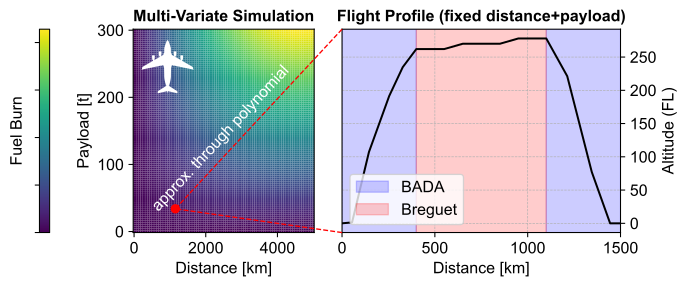
Payload/Range Diagram

In this model, fuel burn calculations are based on a regression model. The regression coefficients were obtained by fitting mission parameters to fuel burn data obtained from a combination of Eurocontrol BADA flight trajectory simulation model and the Breguet range equation. Climb and descent segment fuel burn is calculated using the Eurocontrol BADA model. Cruise segment fuel burn is calculated using the Breguet range equation.

Fuel burn is calculated according to Table 5 in Yanto and Liem (2017):

\[ W_f = c_R \cdot R + c_P \cdot PL + c_C \]

where:

Symbol Dimension Description
\(W_f\) [mass] Fuel required for the mission of the aircraft
\(R\) [distance] Range of the aircraft (=mission distance)
\(PL\) [mass] Payload mass of the aircraft
\(c_R\) [mass/distance] Regression coefficient for range
\(c_P\) [mass/mass] Regression coefficient for payload
\(c_C\) [mass] Constant term
Notes

Key assumptions of this fuel calculation function:

Parameter Assumption
data availability 37 selected aircraft
aircraft payload variable
climb/descent considered implicitly
reserve fuel uplift assumed constant at "0.08 zero-fuel weight" (cf. P.577)
diversion fuel uplift unknown
References

Yanto, J., & Liem, R. P. (2017). Efficient fast approximation for aircraft fuel consumption for decision-making and policy analysis. In AIAA Modeling and Simulation Technologies Conference (p. 3338). doi:10.2514/6.2017-3338

Warnings

The x-axis of all three panels in Figure 14 in Lee et al. (2010) are incorrectly rendered. According to panel (a), the maximum achievable range of a Boeing 777 would be ~30'000NM. This is ~1.6x the circumference of the Earth. Neither assuming that the axis multiplier 1e4 nor the unit nm (sic!) are incorrect explains this issue. Figure 5 was instead used to test the implementation of the method.

Example

Editor (session: default) Run
import jetfuelburn
from jetfuelburn import ureg
from jetfuelburn.reducedorder import yanto_etal
yanto_etal.available_aircraft()[0:10]
yanto_etal.calculate_fuel_consumption(
    acft='A321',
    R=2200*ureg.km,
    PL=18*ureg.metric_ton
)
Output Clear
Source code in jetfuelburn/reducedorder.py
class yanto_etal:
    r"""
    This class implements the the reduced-order fuel burn model of Yanto and Liem (2017):

    ![Payload/Range Diagram](../_static/reduced_order_yanto_etal.svg)

    In this model, fuel burn calculations are based on a regression model.
    The regression coefficients were obtained by fitting mission parameters to fuel burn data obtained
    from a combination of Eurocontrol BADA flight trajectory simulation model and the Breguet range equation.
    Climb and descent segment fuel burn is calculated using the [Eurocontrol BADA](https://www.eurocontrol.int/model/bada) model.
    Cruise segment fuel burn is calculated using the Breguet range equation.

    Fuel burn is calculated according to Table 5 in Yanto and Liem (2017):

    $$
        W_f = c_R \cdot R + c_P \cdot PL + c_C
    $$

    where:

    | Symbol     | Dimension         | Description                                                            |
    |------------|-------------------|------------------------------------------------------------------------|
    | $W_f$      | [mass]            | Fuel required for the mission of the aircraft                          |
    | $R$        | [distance]        | Range of the aircraft (=mission distance)                              |
    | $PL$       | [mass]            | Payload mass of the aircraft                                           |
    | $c_R$      | [mass/distance]   | Regression coefficient for range                                       |
    | $c_P$      | [mass/mass]       | Regression coefficient for payload                                     |
    | $c_C$      | [mass]            | Constant term                                                          |

    Notes
    -----
    Key assumptions of this fuel calculation function:

    | Parameter             | Assumption                                                                  |
    |-----------------------|-----------------------------------------------------------------------------|
    | data availability     | 37 selected aircraft                                                        |
    | aircraft payload      | variable                                                                    |
    | climb/descent         | considered implicitly                                                       |
    | reserve fuel uplift   | assumed constant at _"0.08 zero-fuel weight"_ (cf. P.577)                   |
    | diversion fuel uplift | unknown                                                                     |

    References
    ----------
    Yanto, J., & Liem, R. P. (2017).
    Efficient fast approximation for aircraft fuel consumption for decision-making and policy analysis.
    In _AIAA Modeling and Simulation Technologies Conference_ (p. 3338).
    doi:[10.2514/6.2017-3338](https://doi.org/10.2514/6.2017-3338)

    Warnings
    --------
    The x-axis of all three panels in Figure 14 in Lee et al. (2010) are incorrectly rendered.
    According to panel (a), the maximum achievable range of a Boeing 777 would be ~30'000NM. This is ~1.6x the circumference of the Earth.
    Neither assuming that the axis multiplier `1e4` nor the unit `nm` (sic!) are incorrect explains this issue.
    Figure 5 was instead used to test the implementation of the method.

    Example
    -------
    ```pyodide install='jetfuelburn'
    import jetfuelburn
    from jetfuelburn import ureg
    from jetfuelburn.reducedorder import yanto_etal
    yanto_etal.available_aircraft()[0:10]
    yanto_etal.calculate_fuel_consumption(
        acft='A321',
        R=2200*ureg.km,
        PL=18*ureg.metric_ton
    )
    ```
    """

    _regression_coefficients = {
        "A319": {"c_R": 1.809, "c_P": 0.145, "c_C": 580.83},
        "A320": {"c_R": 1.984, "c_P": 0.138, "c_C": 390.97},
        "A332": {"c_R": 8.305, "c_P": 0.341, "c_C": -2314.39},
        "A333": {"c_R": 8.278, "c_P": 0.329, "c_C": 706.80},
        "B731": {"c_R": 2.085, "c_P": 0.148, "c_C": 125.44},
        "B733": {"c_R": 2.099, "c_P": 0.146, "c_C": 470.24},
        "B734": {"c_R": 2.412, "c_P": 0.16, "c_C": 431.29},
        "B735": {"c_R": 1.825, "c_P": 0.117, "c_C": 631.40},
        "B736": {"c_R": 1.922, "c_P": 0.185, "c_C": 517.48},
        "B737": {"c_R": 2.063, "c_P": 0.165, "c_C": 915.72},
        "B738": {"c_R": 2.539, "c_P": 0.157, "c_C": 484.68},
        "B739": {"c_R": 2.507, "c_P": 0.172, "c_C": 503.32},
        "B739ER": {"c_R": 2.547, "c_P": 0.18, "c_C": 328.96},
        "B752": {"c_R": 2.966, "c_P": 0.168, "c_C": 443.28},
        "B753": {"c_R": 3.242, "c_P": 0.177, "c_C": 762.16},
        "B772": {"c_R": 6.724, "c_P": 0.396, "c_C": -7634.59},
        "B773": {"c_R": 8.163, "c_P": 0.371, "c_C": -8576.72},
        "CRJ2": {"c_R": 1.045, "c_P": 0.116, "c_C": 140.42},
        "CRJ9": {"c_R": 1.271, "c_P": 0.141, "c_C": 778.27},
        "E145": {"c_R": 0.705, "c_P": 0.134, "c_C": 601.88},
        "MD80": {"c_R": 2.463, "c_P": 0.152, "c_C": -67.81},
        "A318": {"c_R": 1.407, "c_P": 0.172, "c_C": 17.29},
        "A321": {"c_R": 2.61, "c_P": 0.176, "c_C": 880.53},
        "A343": {"c_R": 8.81, "c_P": 0.424, "c_C": -5057.09},
        "A345": {"c_R": 10.86, "c_P": 0.453, "c_C": -9708.52},
        "A342": {"c_R": 8.36, "c_P": 0.348, "c_C": -290.49},
        "A346": {"c_R": 12.428, "c_P": 0.385, "c_C": -8552.62},
        "B742": {"c_R": 10.06, "c_P": 0.403, "c_C": -8964.48},
        "B744": {"c_R": 8.779, "c_P": 0.247, "c_C": -9191.53},
        "B762": {"c_R": 4.102, "c_P": 0.228, "c_C": 716.20},
        "B763": {"c_R": 5.159, "c_P": 0.279, "c_C": -2282.61},
        "CRJ7": {"c_R": 1.194, "c_P": 0.143, "c_C": 725.06},
        "CRJ1": {"c_R": 0.781, "c_P": 0.169, "c_C": 351.56},
        "E140": {"c_R": 0.673, "c_P": 0.133, "c_C": 633.03},
        "E170": {"c_R": 1.19, "c_P": 0.144, "c_C": 949.164},
        "E190": {"c_R": 1.626, "c_P": 0.145, "c_C": 1219.34},
        "MD90": {"c_R": 2.157, "c_P": 0.117, "c_C": 643.18},
    }

    @staticmethod
    def available_aircraft() -> list[str]:
        """
        Returns a sorted list of available ICAO aircraft designators included in the model.
        """
        return sorted(yanto_etal._regression_coefficients.keys())

    @staticmethod
    @ureg.check(
        None,  # acft
        "[length]",
        "[mass]",
    )
    def calculate_fuel_consumption(
        acft: str,
        R: float,
        PL: float,
    ) -> float:
        """
        Given an ICAO aircraft designator, mission range and payload mass, calculates the fuel burned.

        Parameters
        ----------
        acft : str
            ICAO Aircraft Designator
        R : float
            Mission range [length]
        PL : float
            Payload mass [mass]

        Raises
        ------
        ValueError
            If the ICAO aircraft designator is not found in the model data.
        ValueError
            If range or payload are less than zero.

        Returns
        -------
        float
            Fuel mass [kg]
        """
        if R < 0:
            raise ValueError("Range must be greater than zero.")
        if PL < 0:
            raise ValueError("Payload mass must be greater than zero.")
        if acft not in yanto_etal._regression_coefficients.keys():
            raise ValueError(
                f"ICAO Aircraft Designator '{acft}' not found in model data. Please select one of the following: {yanto_etal._regression_coefficients.keys()}"
            )

        R = R.to("km").magnitude
        PL = PL.to("kg").magnitude

        m_f = (
            yanto_etal._regression_coefficients[acft]["c_R"] * R
            + yanto_etal._regression_coefficients[acft]["c_P"] * PL
            + yanto_etal._regression_coefficients[acft]["c_C"]
        )

        return m_f * ureg("kg")

available_aircraft staticmethod

available_aircraft()

Returns a sorted list of available ICAO aircraft designators included in the model.

Source code in jetfuelburn/reducedorder.py
@staticmethod
def available_aircraft() -> list[str]:
    """
    Returns a sorted list of available ICAO aircraft designators included in the model.
    """
    return sorted(yanto_etal._regression_coefficients.keys())

calculate_fuel_consumption staticmethod

calculate_fuel_consumption(acft, R, PL)

Given an ICAO aircraft designator, mission range and payload mass, calculates the fuel burned.

Parameters:

Name Type Description Default
acft str

ICAO Aircraft Designator

required
R float

Mission range [length]

required
PL float

Payload mass [mass]

required

Raises:

Type Description
ValueError

If the ICAO aircraft designator is not found in the model data.

ValueError

If range or payload are less than zero.

Returns:

Type Description
float

Fuel mass [kg]

Source code in jetfuelburn/reducedorder.py
@staticmethod
@ureg.check(
    None,  # acft
    "[length]",
    "[mass]",
)
def calculate_fuel_consumption(
    acft: str,
    R: float,
    PL: float,
) -> float:
    """
    Given an ICAO aircraft designator, mission range and payload mass, calculates the fuel burned.

    Parameters
    ----------
    acft : str
        ICAO Aircraft Designator
    R : float
        Mission range [length]
    PL : float
        Payload mass [mass]

    Raises
    ------
    ValueError
        If the ICAO aircraft designator is not found in the model data.
    ValueError
        If range or payload are less than zero.

    Returns
    -------
    float
        Fuel mass [kg]
    """
    if R < 0:
        raise ValueError("Range must be greater than zero.")
    if PL < 0:
        raise ValueError("Payload mass must be greater than zero.")
    if acft not in yanto_etal._regression_coefficients.keys():
        raise ValueError(
            f"ICAO Aircraft Designator '{acft}' not found in model data. Please select one of the following: {yanto_etal._regression_coefficients.keys()}"
        )

    R = R.to("km").magnitude
    PL = PL.to("kg").magnitude

    m_f = (
        yanto_etal._regression_coefficients[acft]["c_R"] * R
        + yanto_etal._regression_coefficients[acft]["c_P"] * PL
        + yanto_etal._regression_coefficients[acft]["c_C"]
    )

    return m_f * ureg("kg")